Sky Above.
← PARAM BAHIA
Sky Above.
A tool for understanding yourself. Astrology done with the precision of an instrument and the voice of a friend.
Sky Above.
A tool for understanding yourself. Astrology done with the precision of an instrument and the voice of a friend.
Sky Above started as a question — could the actual mathematics of astrology be made readable, useful, and personal? Most products in this space pick one — they’re either accurate or accessible. The bet was that you could be both.
It started as a custom GPT shared with friends and family. From there: a real product, real birth-data calculations to the arcminute via Swiss Ephemeris, AI-interpreted prose readings that don’t recycle, a chat interpreter that stays grounded in your specific chart, compatibility tooling, and a learning library for the curious.
Free, and live.
Relaunched on 11 October. The ephemeris was rebuilt from the ground up, and the whole site was brought under one design — one header, one shell, one set of components, a lint that fails the build when a page drifts from it. The reading is no longer a wall of prose: the Pattern Deck distils it into cards you keep. A Today edition is composed on a schedule rather than on demand, and Meridian marks the week. The old compatibility pages are gone; in their place, People — the charts of the people in your life, read side by side — and Ask, which answers with both charts in context.
Four hundred tests hold the backend still. Payments exist behind a flag that stays off. A phone build exists and is not on the store. Still free. The first screens below are from the relaunch; the older set follows, kept for the record.
14 / 20 · Sky Above — The relaunch, from the ephemeris up
I rebuilt the ephemeris from the ground up, and every position in the product is computed from it to the arcminute.
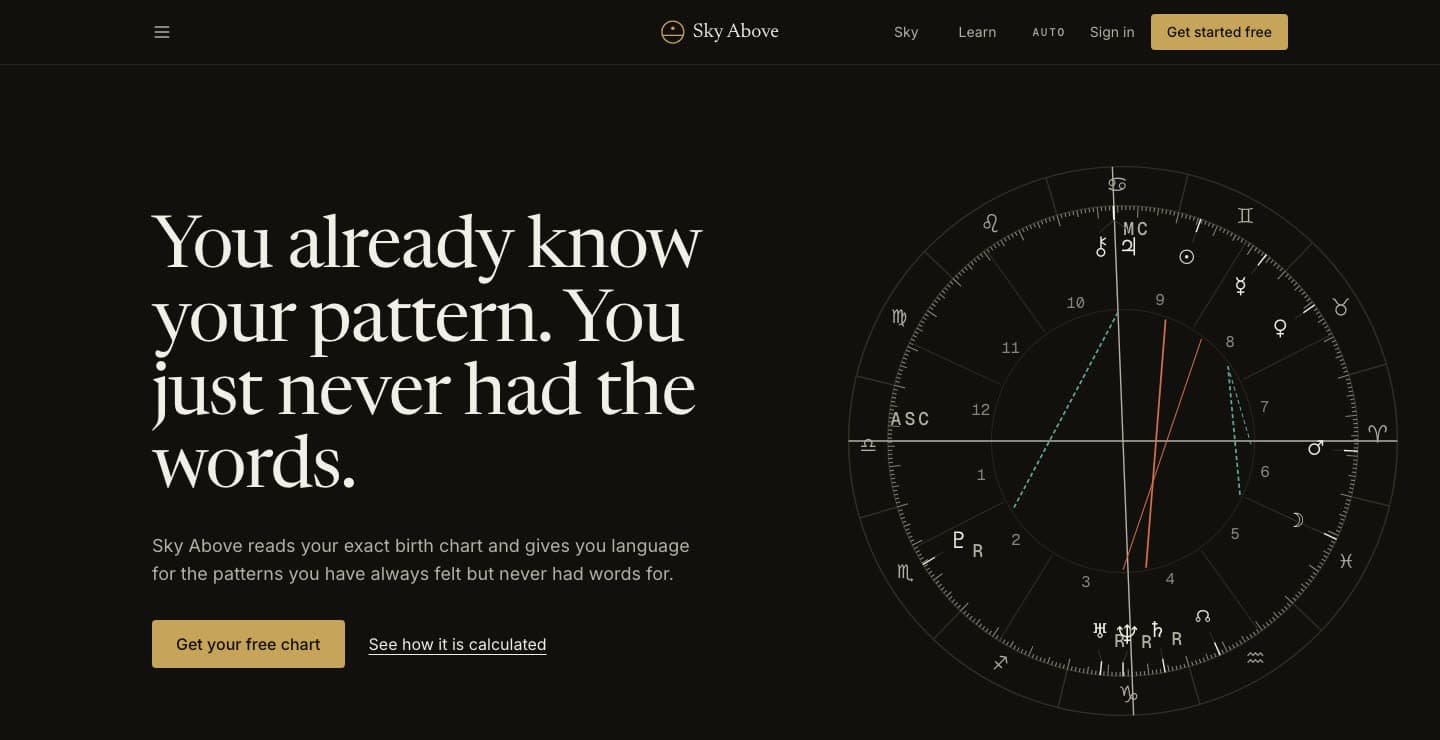
The chart wheel on the landing is drawn from the ephemeris, not an illustration.
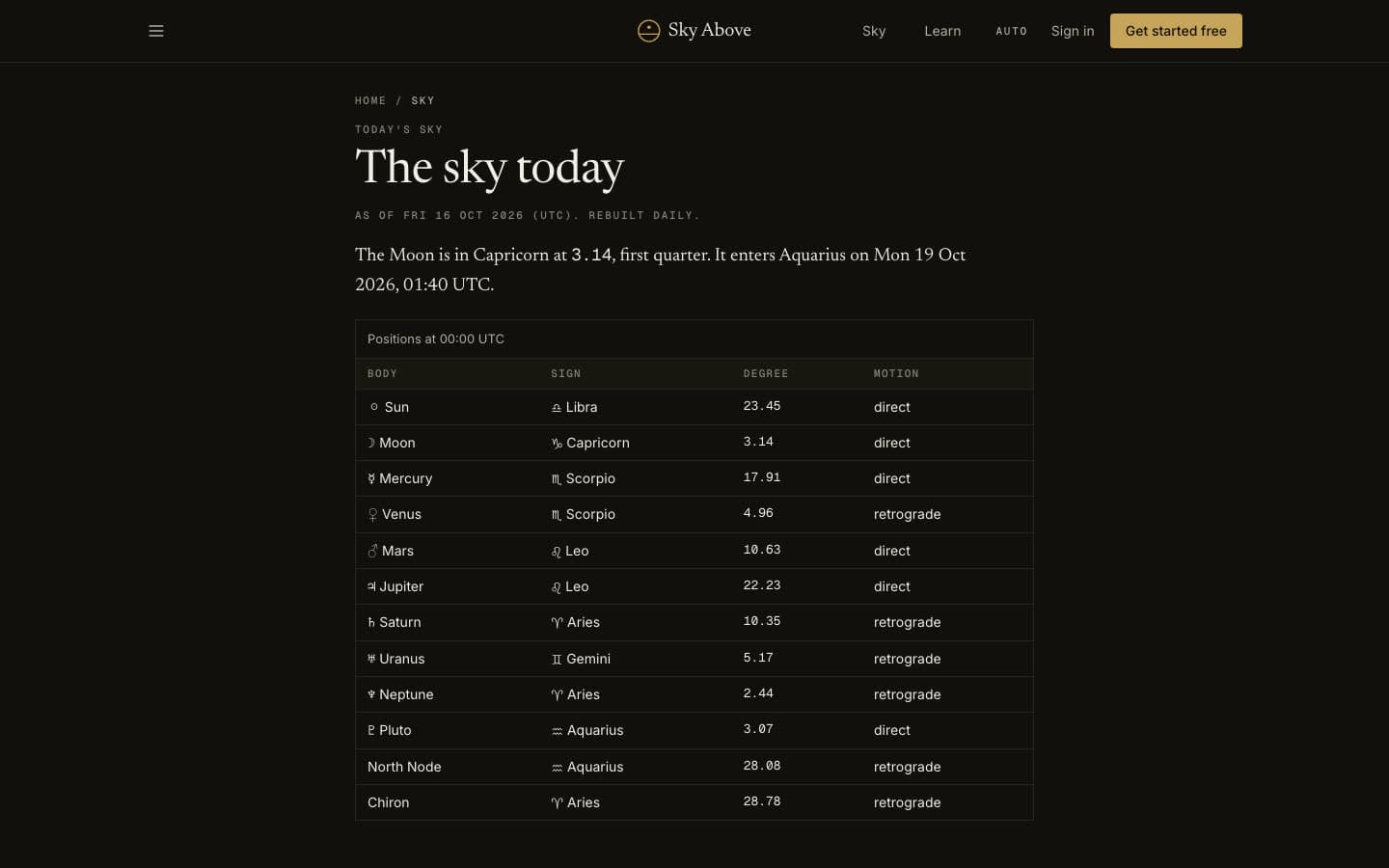
A plain table of positions by sign, degree and motion, rebuilt daily and open to anyone without an account.
The reading interprets your own chart in prose that does not recycle, grounded in the placements underneath it.
The reading no longer arrives as a wall of prose: the Pattern Deck distils it into cards you keep.
Today is composed on a schedule rather than on demand, so the day is written before anyone asks for it.
Meridian marks the week, composed on its own schedule.
The old compatibility pages are gone; People holds the charts of the people in your life, read side by side.
Ask answers with both charts in context and stays grounded in actual placements, never in generic memes.
I brought the whole site under one header, one shell and one set of components, with a lint that fails the build when a page drifts.