Inner Axis.
ANSWER
MAP
RESEMBLE
READ
Inner Axis.
A reading of the company your ideas keep — the philosophical traditions your answers resemble, mapped as a night sky you stand at the centre of. And a thing that came full circle.
About eighteen months ago I built a custom GPT called the worldview oracle. It was the first time I understood what this technology actually was — I had prompted it to help me read my own worldview back to me, and the thing it did with that was startling. I shared it around; it put me on a path. I started coding on Lovable to give it a real home, wired it up, didn’t like how it worked, and stepped back — that detour became Sky Above. The idea kept its domain and went quiet. Eighteen months later I thought: enough. I’ll just make it and put it out there. This is that, come full circle.
Inner Axis reads the company your ideas keep. It opens with a few broad prompts you answer in your own words, then adapts — a progressive interview that deepens only where you were ambiguous, and once, when it catches your sharpest tension, mirrors it back to you as an open question rather than a verdict. Or skip the interview and paste something you already wrote. Either way it shows which philosophical traditions your expressed views most resemble, mapped across nine fundamental axes: reality, knowledge, morality, meaning, human nature, freedom, society, authority, change. It is the text sibling of Kallos, and deliberately its opposite geometry: Kallos reads a portrait, a face; Inner Axis reads a position in space — a star chart you stand at the centre of.
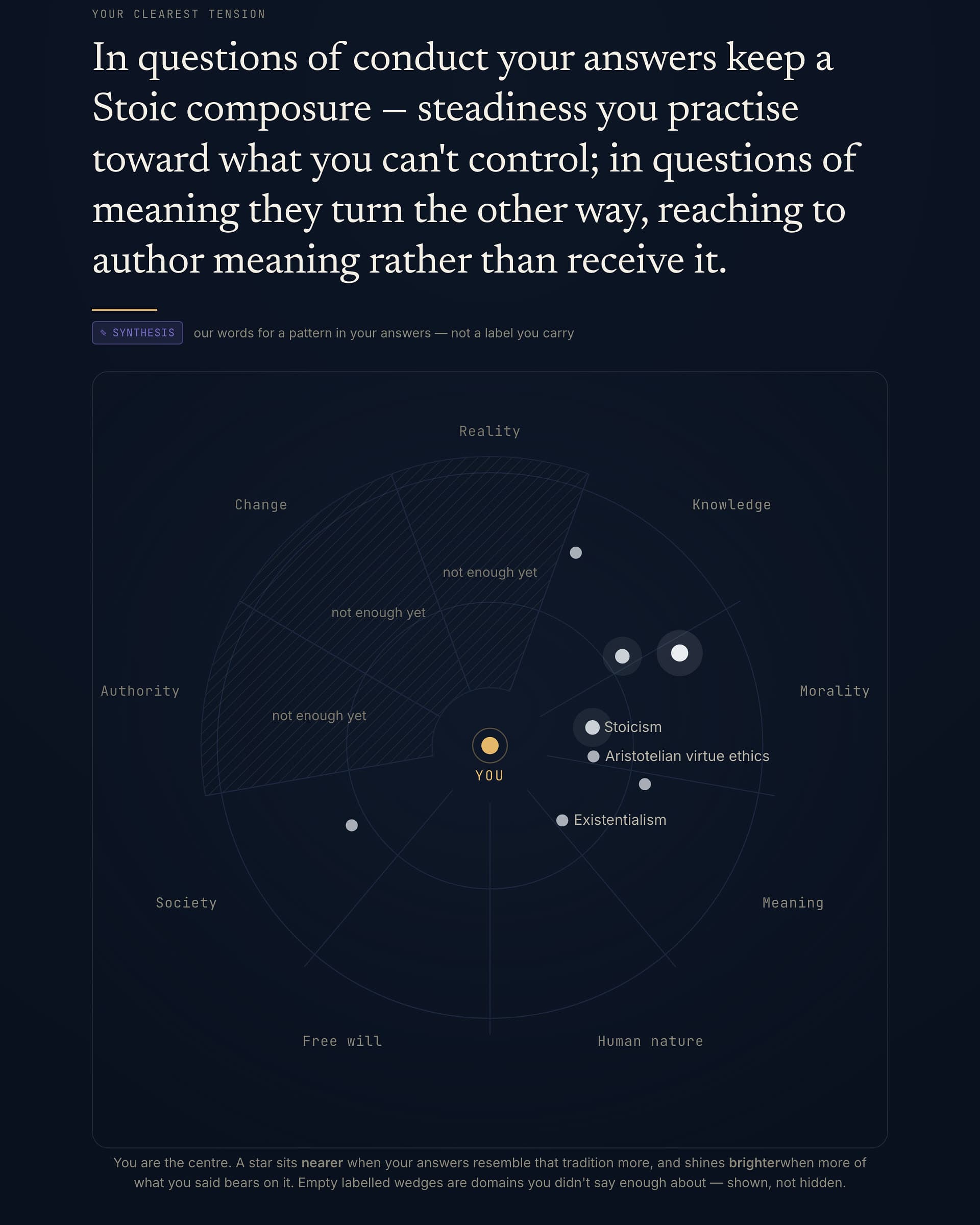
The reading is a constellation. You are the gold point at the middle. Each tradition is a star: it sits nearer when your answers resemble it more, and shines brighter when more of what you said bears on it — two independent channels, so a tradition can be close but faint, or distant but bright. Above it sits your clearest tension — not a type, not a score, but the thing you do when your own principles collide. Mine, in the sample: a Stoic composure in matters of conduct that turns the other way in matters of meaning, reaching to author it rather than receive it.
The honesty is the whole product, and it’s the reason it exists. The original oracle promised “high-precision psychological profiling.” That claim cannot be delivered honestly, so Inner Axis refuses to make it. It reads this session’s answers, not your soul — resemblance, not diagnosis; no type, no percentage, no verdict about who you are. Every claim in the reading carries a provenance tag: what you said outright, what merely follows from it, where it resembles a documented tradition, and — shown, never hidden — where you didn’t say enough for anything to be placed at all. Those empty axes stay on the chart as labelled dark wedges. Abstention over confabulation. The rule is enforced in code, not just intention: a test suite bans the language of diagnosis from every screen.
Under it, the engine ported from Kallos: an adaptive self-consistency vote across multiple passes that fans out when the read is ambiguous and fails closed on anything unsafe, with an independent validator — the model that writes the reading is never the model that checks it. Your text is processed in the moment and never stored. And when the reading lands you can talk to it: an analyst chat grounded strictly in what your reading actually found — session-only, turn-capped, and it refuses to pretend to be you or to answer for a domain the reading left open. Built in a day, live at its own domain — and, honestly, still being tuned. It is not the finished thing yet. It is out there while I make it better.