LandSignal.
A developer sees the site first, or he does not get it at all. This watches the record for him.
It started at a family birthday. I got talking to a relative’s business partner — land, planning, new homes — and what he described was a hunt: dozens of council portals, weekly lists that do not talk to each other, records scattered across bodies that have no reason to agree, and a window that closes the moment anybody else notices. It sounded interesting, so we kept talking. Then my brain went off. I built it, took it back to him, and the conversation has not stopped since.
The first premise was wrong, and the data said so inside a day. I had assumed forced-sale notices publish about a month ahead of the open market — build the ingestion engine and let the search prove the premise as it runs. It did not. What the research handed back instead was the better idea: the value this man creates is upstream of construction, in finding land, controlling it, and winning the planning uplift. So the engine turned. Planning became the primary signal; distress stayed on as a secondary lens rather than the whole thesis.
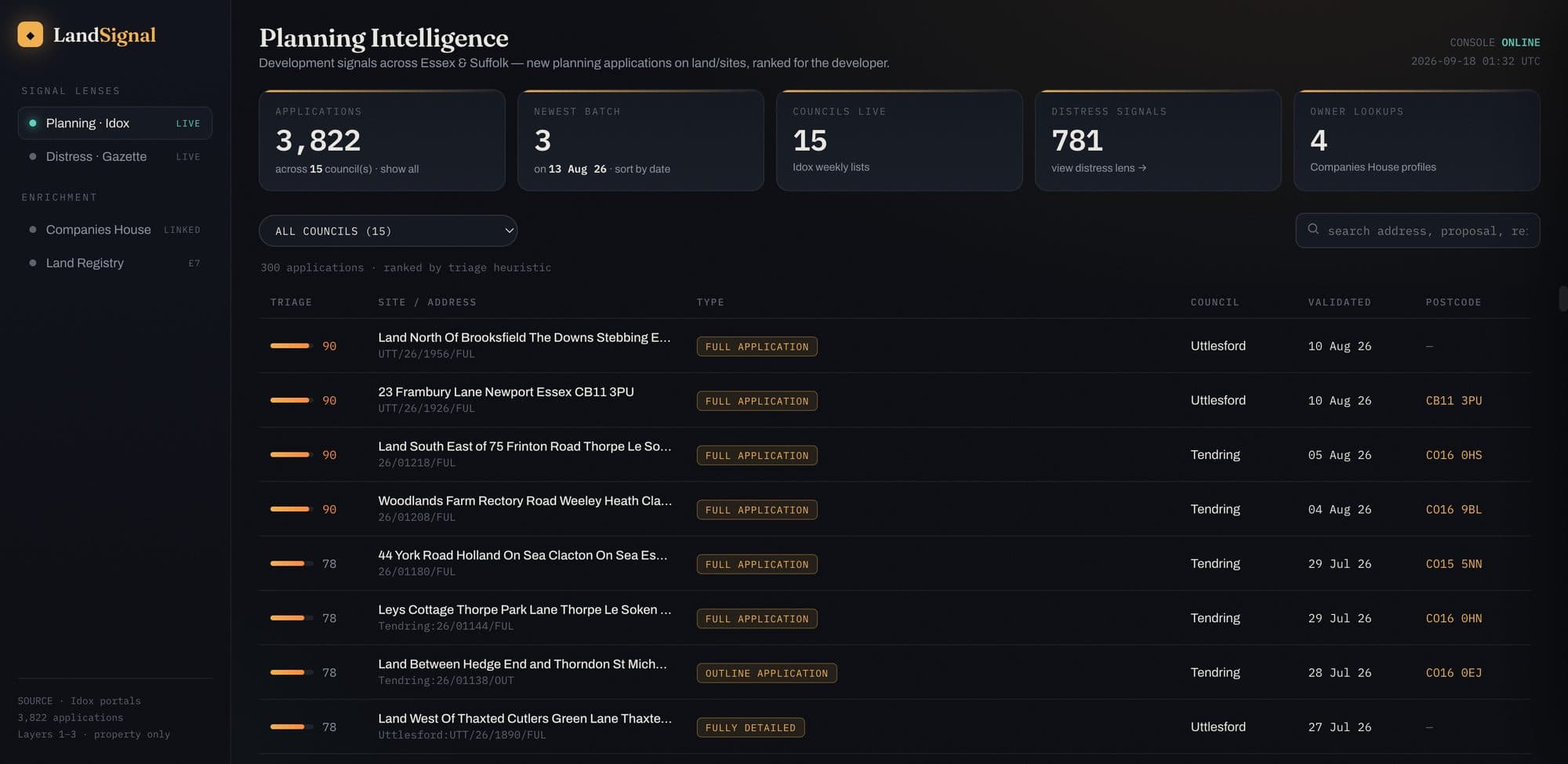
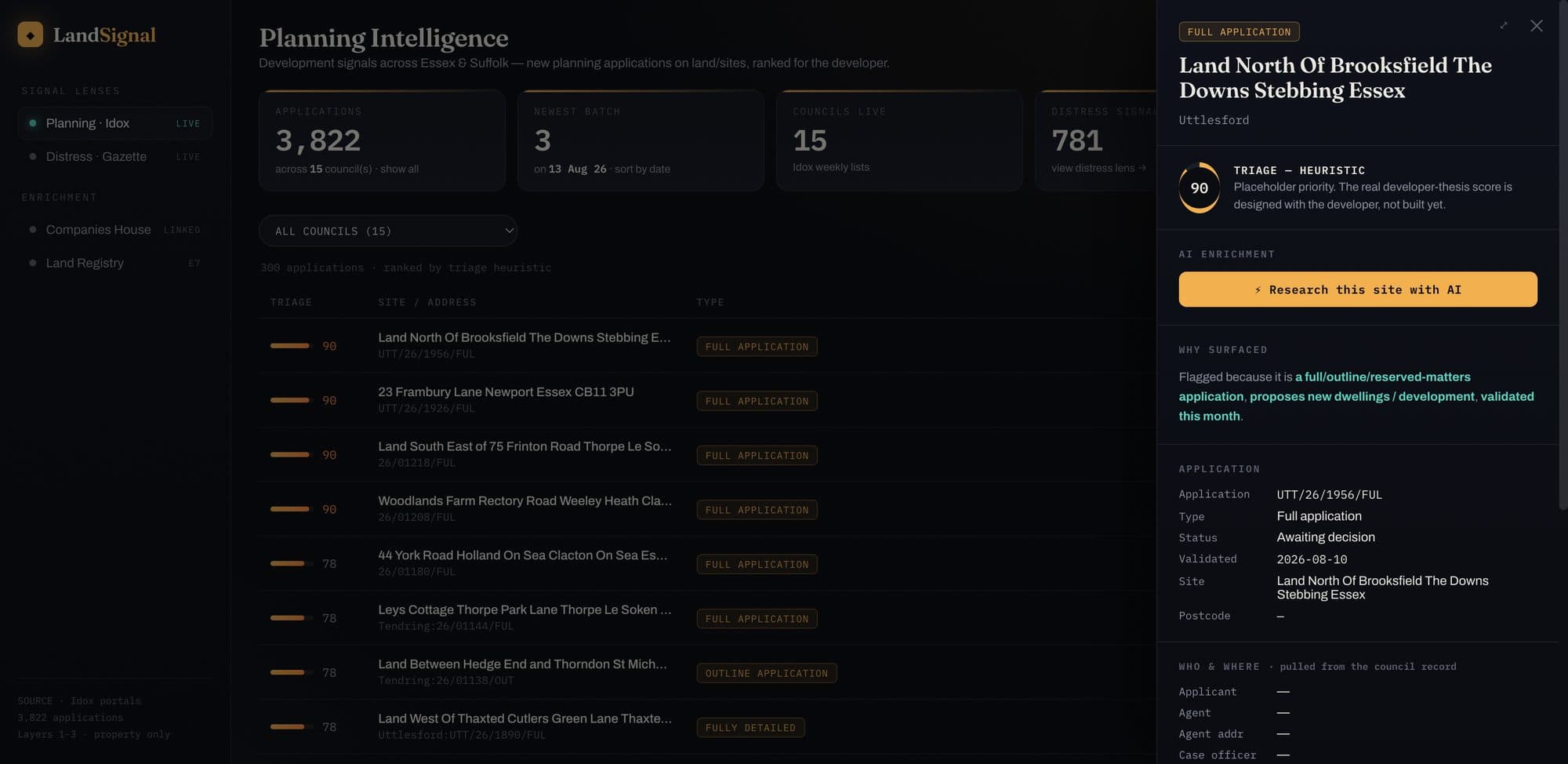
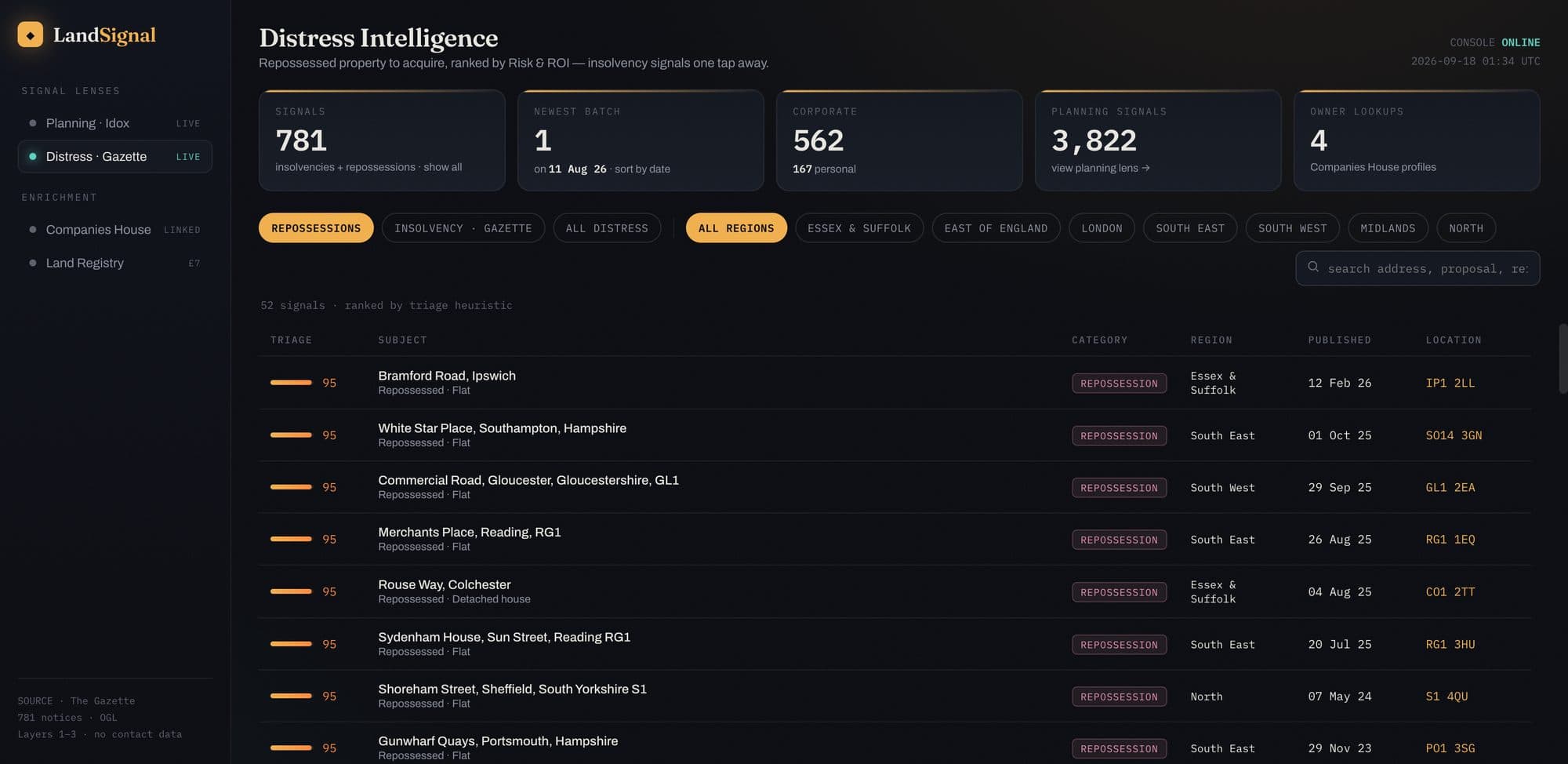
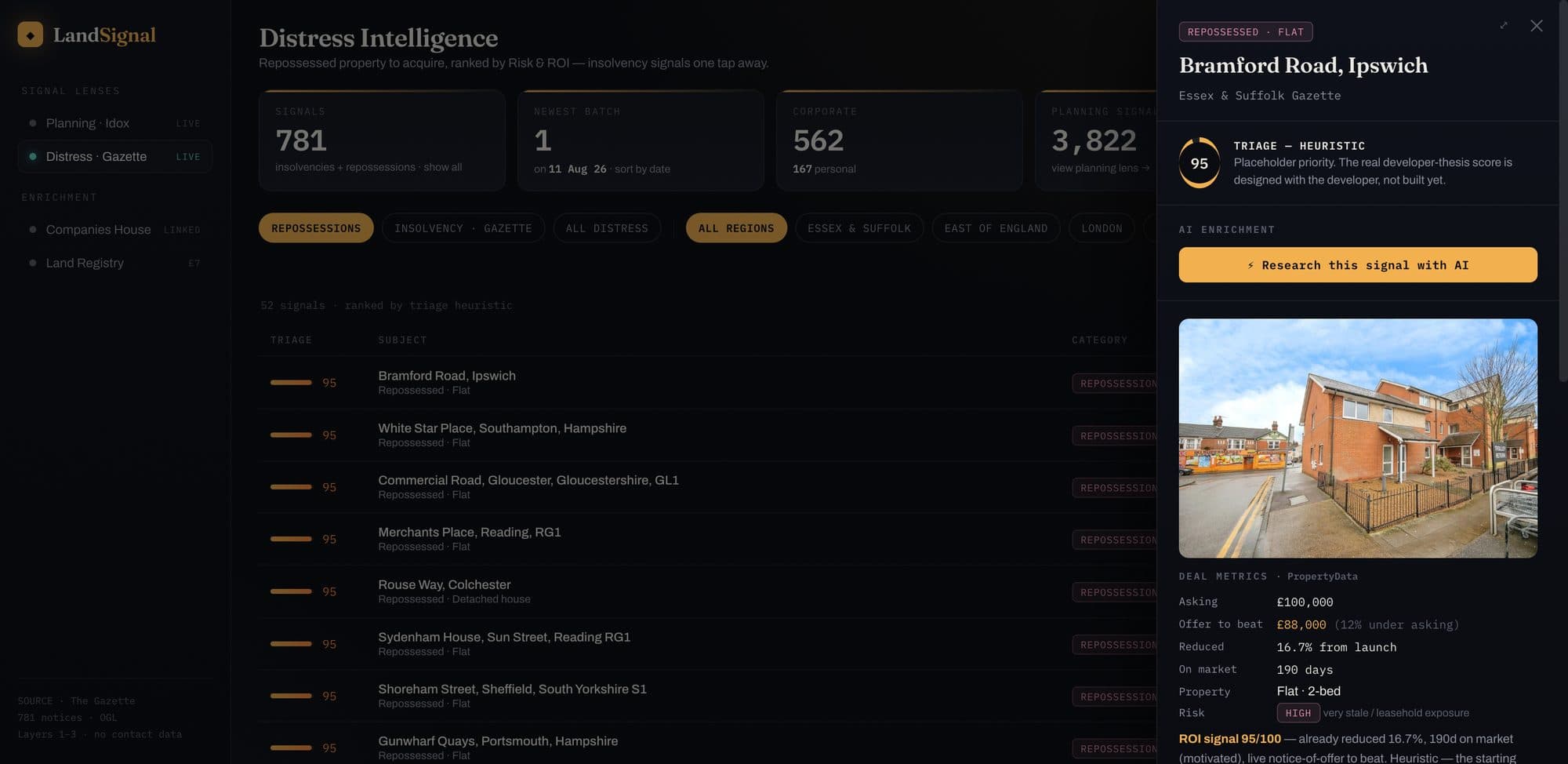
LandSignal reads public sources and turns them into ranked, explainable signals. Planning applications straight off the council portals — 3,822 of them across fifteen councils in Essex and Suffolk, with the proposal text verbatim and the case reference intact. Insolvency notices from The Gazette under its open licence. Repossessed stock nationwide, organised by region. Ownership from Companies House. Every signal carries why it surfaced, the source it came from, its reference, the date it was retrieved, and a link back to the original record. No bare scores anywhere: a number you cannot open is a number you cannot trust.
Two rules hold the rest of it honest. Detecting a property is not the same as identifying a person — property intelligence, ownership enrichment, contact eligibility and human-approved outreach are separate stages by design, and the console stops at the property with no contact data in it. And money moves only on evidence: a paid lookup runs after a signal clears a threshold, never speculatively, and every one of them has to justify itself.
In August I put the console in front of him and the feedback came back fast and specific. The layout worked, which counted for a lot with someone who would be the first to tell you he is not technical — and that is exactly the bar. The planning sweep worked. The distress lens did not: it was pulling in personal and corporate bankruptcies when what he wanted was repossessions. That is the most valuable thing a pilot user can hand you, a judgement you can encode. Repossessions became the default view the next day, the filters reordered behind it, and the national sweep grew region facets so fifty-two properties across the country read as somewhere rather than everywhere.
It runs on the always-on server now, on a stable address that survives a reboot, so the link he has keeps working without me. The AI research layer is switched off on the public demo on purpose — the cached dossiers still open, but nothing new gets generated by a stranger at my expense. And the triage number is still labelled as what it is: a transparent placeholder heuristic, not the real score. The real score is not mine to invent. It gets built out of the sites he says yes to, the ones he rejects, and the reasons — which is the next conversation, not the next sprint.