Hexis.
Hexis.
A disposition acquired by practice. One record, three clients, and one question — given everything known about me, what should I do next?
Hexis is Aristotle’s word — ἕξις, a settled disposition acquired by practice. Not a talent and not a mood: the state you become by doing a thing, and then doing it again on a day you didn’t want to. The earlier name was the Greek for the body, and it stopped fitting when the body stopped being the whole of it. Everything in the system answers one question — given everything known about my body, my behaviour, my goals and my circumstances, what should I do next?
It began as a refusal. Six and a half years of Fitbit history sat inside a Google Takeout export — a whole record of a life, exported once and left for dead. To free the rest I built an app for my Apple Watch, which got me into the Apple Developer Programme and, with it, HealthKit: the key to the vault. Then I cracked the WHOOP 4.0, reverse-engineered the strap’s Bluetooth and pulled my own history back off it. It streams, and it isn’t finished — I still can’t retire the Watch and run the strap subscription-free. The archive is one index now. One place, one record, mine.
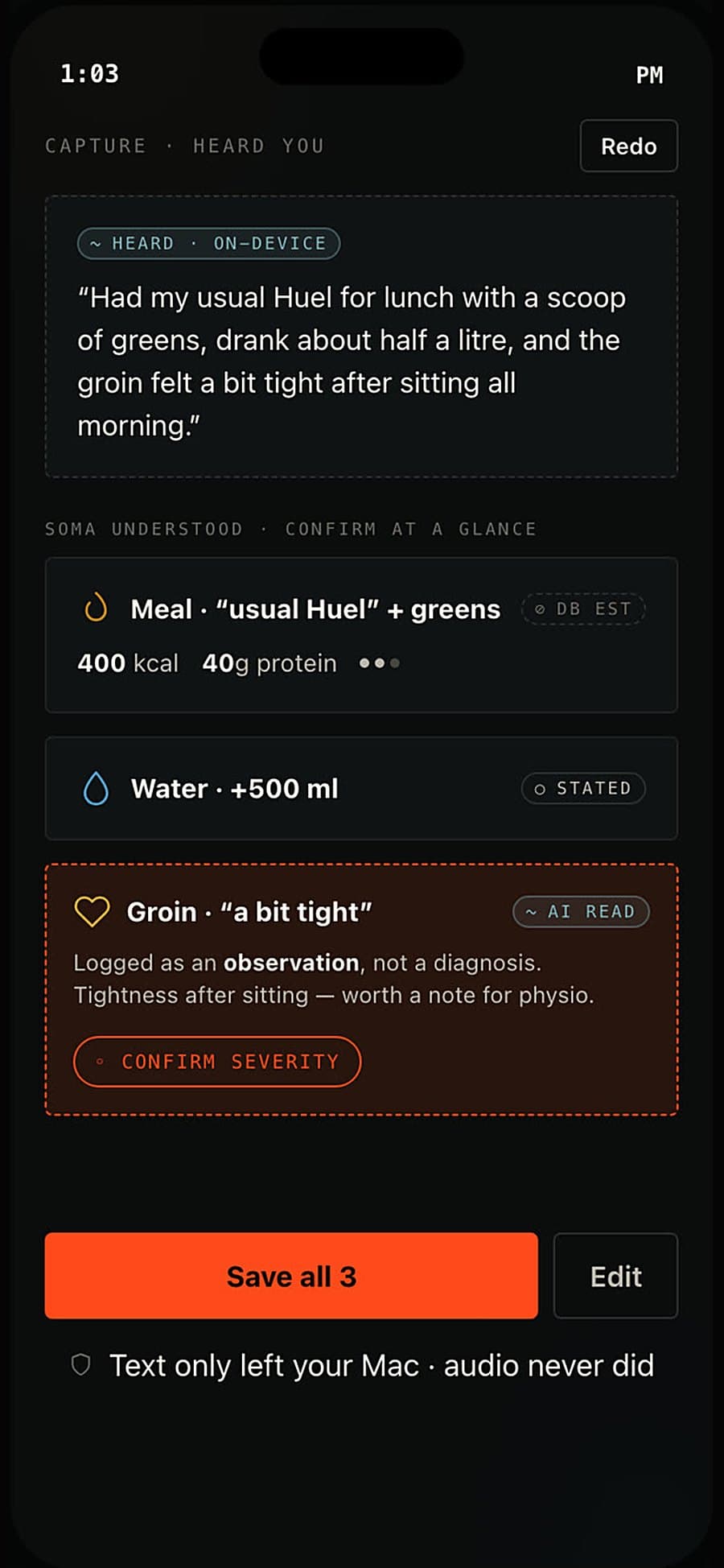
Underneath it is deliberately boring. An append-only event log: every reading filed with its source, its confidence and its provenance, nothing overwritten, corrections layered on top rather than erasing what came before. Deterministic projections recompute any day from the raw events, the same way every time. Above the ledger sits the twin — a continuously updated model of my physical state. I talk to it: say what happened, and speech becomes structured events I confirm rather than forms I fill. It estimates the macros of a meal it has never seen, keeps a repertoire and plans the week from it, reactivates the dinners I stopped cooking, logs the sets, holds the tape measurements and the supplement state. Code does the arithmetic. The model does the interpretation. The ledger stays dumb on purpose.
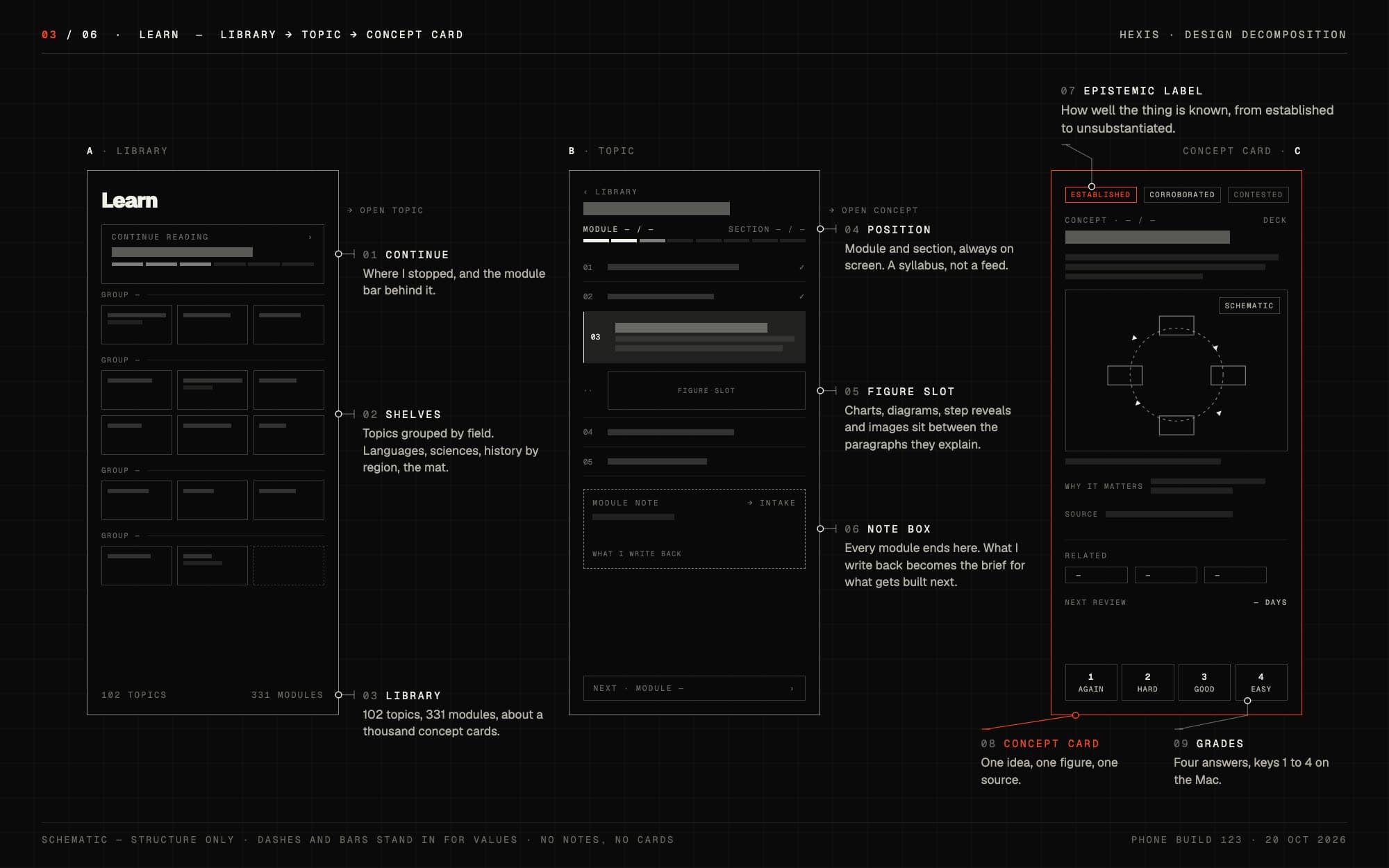
Then it stopped being only a body. Learn started as a Punjabi fluency engine — verbal only, because the honest measure is whether I can hold a conversation, not whether I finished a lesson — and became a library. Spanish followed, then the sciences, history by region, poetry, a Russian shelf, Stoic logic, everything I know about jiu-jitsu written down. Every concept card carries an epistemic label, so a deck tells me how well a thing is known and not only what it says. Each module ends with a note box, and those notes are the next intake — what I write back becomes the brief for what gets built next. A job called Around the World runs nightly, reads what changed and turns what matters into cards. Mind runs adaptive breathwork and mindfulness against the same biometrics, and opens on a daily brief. Life is a living canvas.
When my grandfather passed, I asked for an exhaustive standalone topic on Sikhi — the faith and its history separated from Punjabi culture, the paath translated with the Gurmukhi kept beside the meaning, the Antam Sanskar set out step by step — and it was built overnight, every Gurmukhi line verified, installed on my phone by morning.
In September I gave it a bridge. A sparkle button on Today, Workouts, Food and Learn opens a conversation with a headless Claude session running on my always-on server, the live API behind it and the deployed source in front of it. Threads resume where they stopped. A question gets answered from the real data; a complaint about the interface becomes a ticket I drain the next morning. I can talk to the brain from inside the app.
How deep it goes, plainly: 102 topics, 331 modules, 999 sections, 1,024 concept cards. Sixty specifications between June and September. Three clients over one state — the iPhone runs the full daily loop, the Watch takes the glance, the capture and the live coaching, and a private web client covers the browser. The backend runs on the always-on server at home, reachable over a private mesh and exposed to no one. Six tabs: Today, Mind, Learn, Life, Stats, More. iOS build 117.
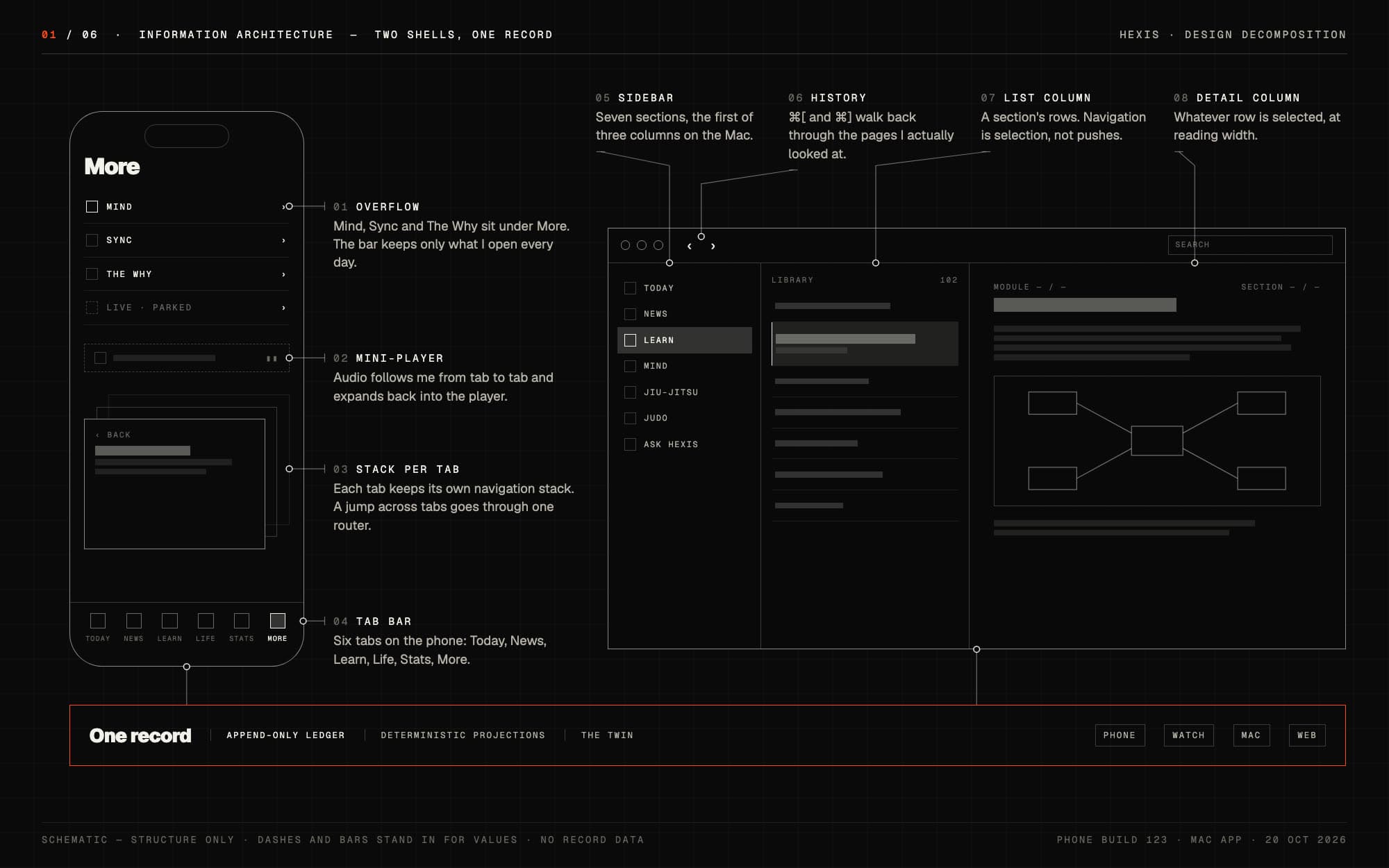
A month on, it sits on the desk as well as in my pocket. The Mac app is a three-column window — seven sections down the side, the rows of a section in the middle, the page itself on the right — and it walks back through exactly the pages I looked at. On the phone, News took a tab of its own and Mind moved under More. Today was rebuilt in October around how I actually use it: the brief, the next module, the audio, the body read passively. Workout and food logging still work, folded away. iPhone build 123. Eighty-five specifications.
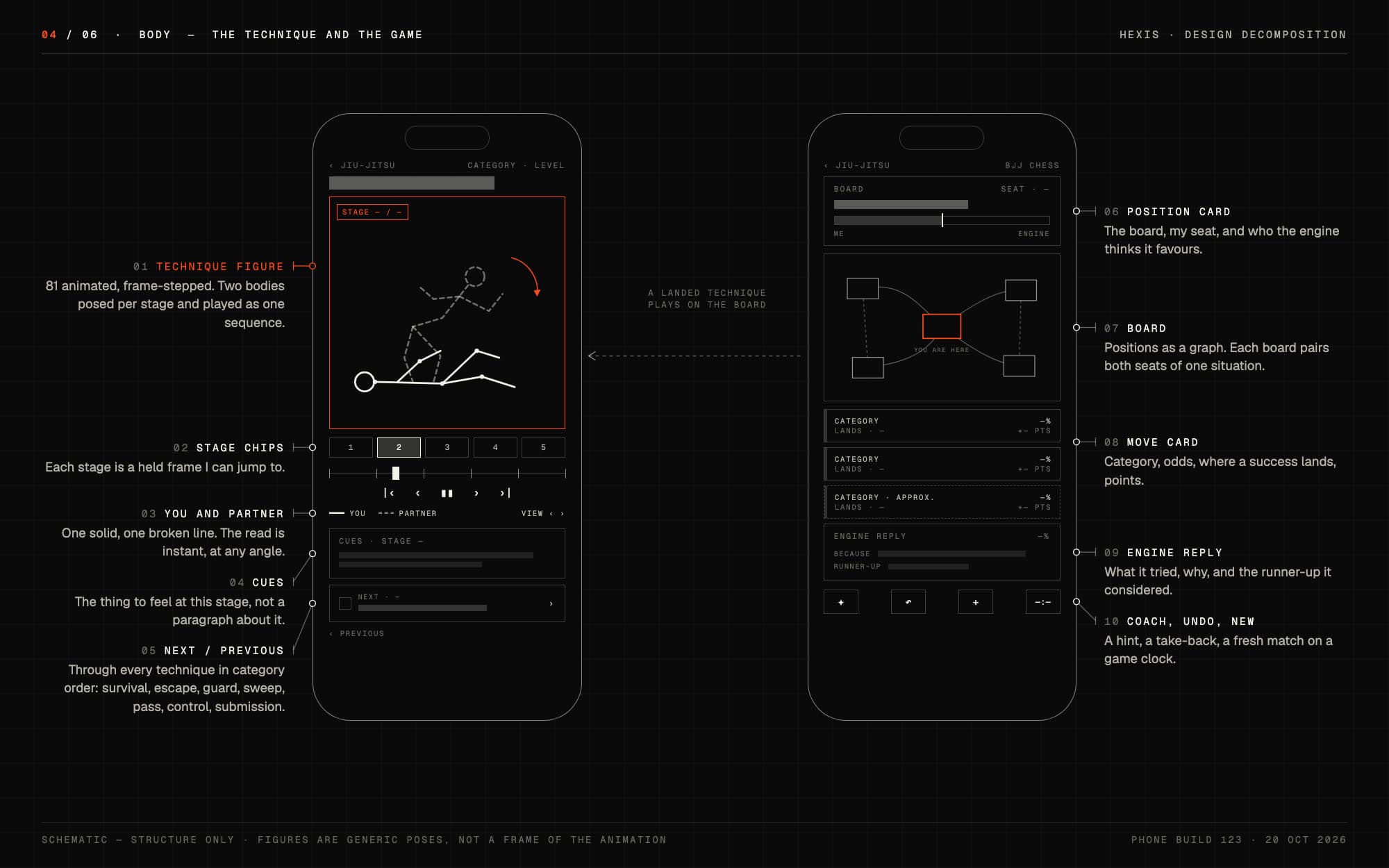
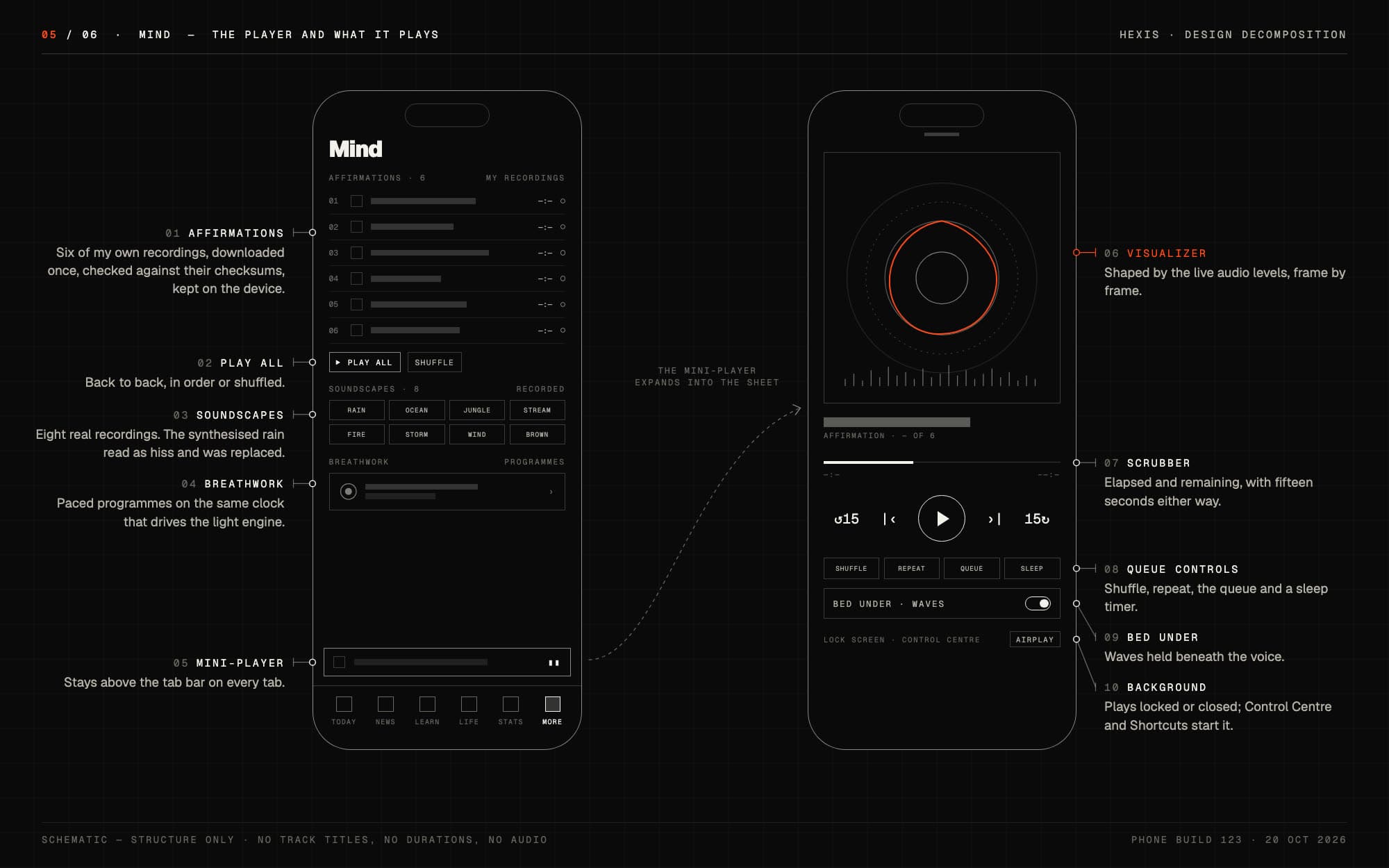
Learn grew figures — charts, diagrams, step reveals and images set between the paragraphs they explain. The mat moved in: eighty-one jiu-jitsu and judo techniques, animated stage by stage, two bodies stepped frame by frame, each page handing on to the next in category order. On top of them sits a chess-style game over positions. I pick a move, it rolls against its odds, and an engine replies with what it tried, why, and the runner-up it considered. Mind became a real player: my own six recordings, back to back, from the lock screen, under a visualizer shaped by the sound.
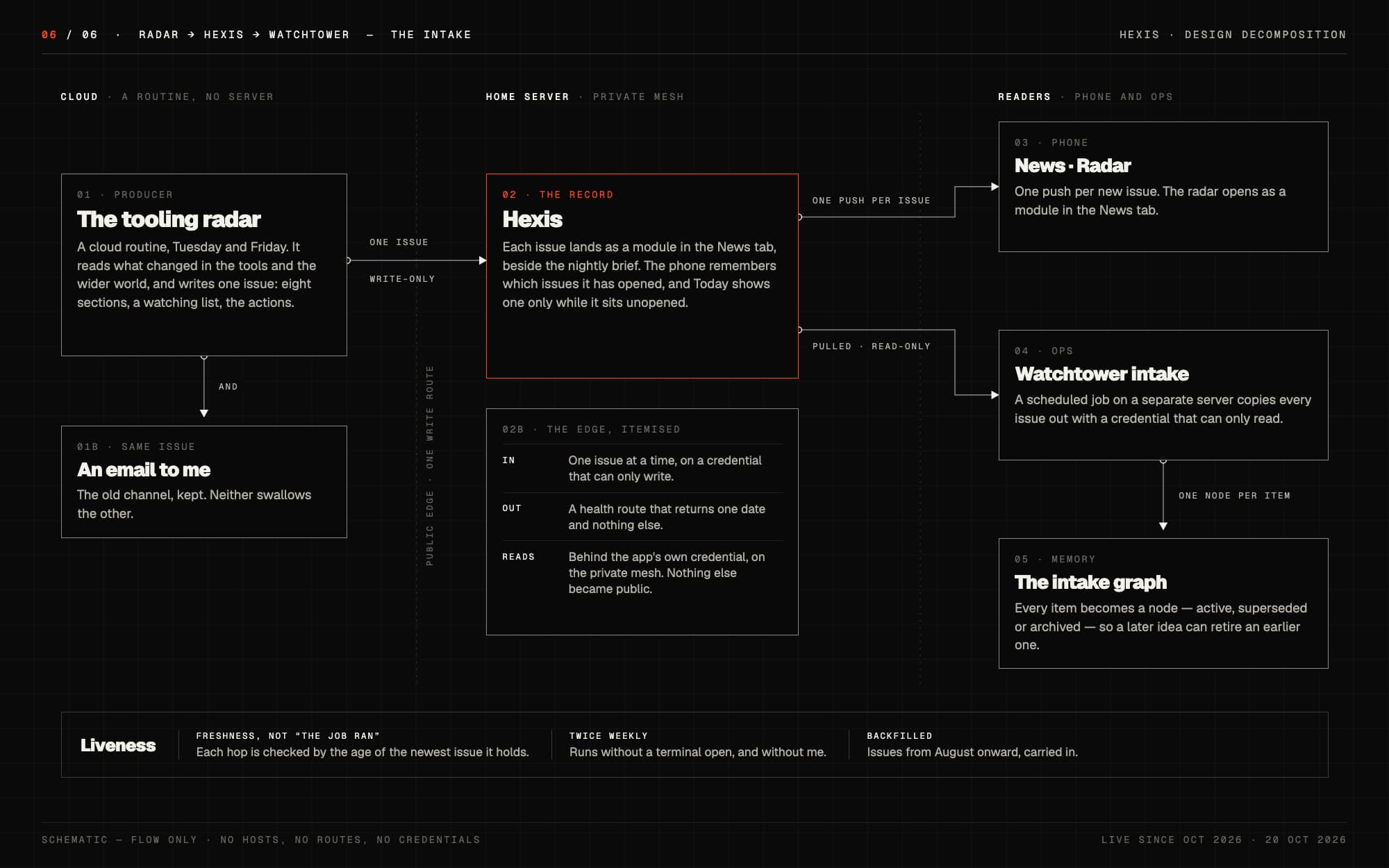
The news arrives as a push now — the nightly brief, headline first, quietly. A second feed runs twice a week: a tooling radar that a cloud routine writes, Hexis files as a module, and my ops layer, Watchtower, copies into an intake where every item becomes a node a later idea can retire. One write route crossed the edge to make that work. Nothing else did.
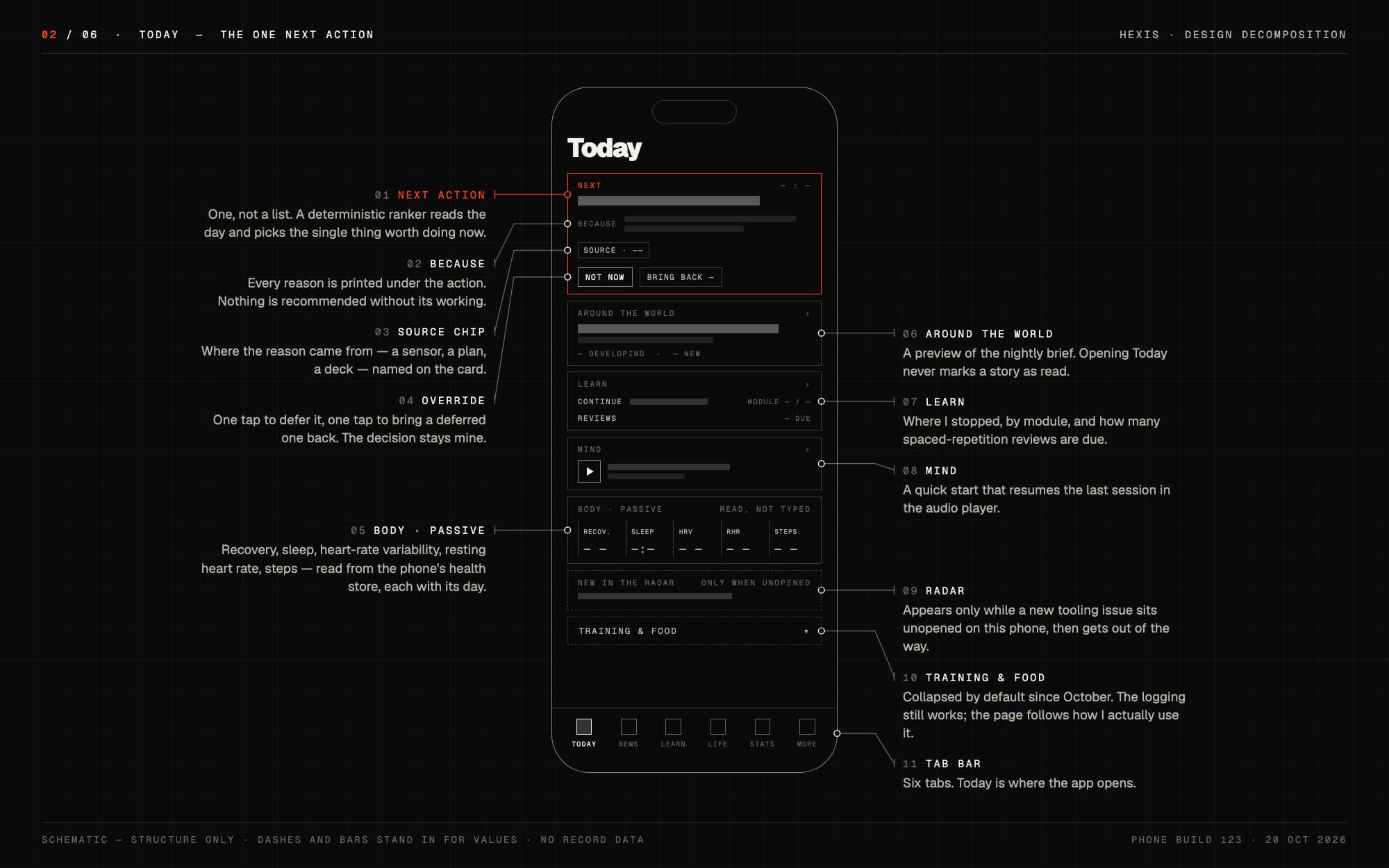
What follows first is not screenshots. I meant to photograph the phone, and the closer I looked the less I wanted to: every real screen carries a reading of my body or a line out of my own head, and the blur that covered the browser frames in September would have covered most of these. So the gallery takes the app apart instead — the structure drawn as a blueprint, each element named with its job. The structure is the public part. The contents are not.
THE BOLT-ONS
None of that was planned in advance. Each piece began as a thought I had while using the thing — if the phone can already flicker light at my closed eyes, why is it not pacing my breath — and ended as another skill on the same record. Never a second app. The system already held the clock, the scheduler and the ledger, so a want arrived as a module on top of what was there rather than as a download. Most of these landed inside one week of August 2026, in this order.
- Light — a programmable light-and-sound engine — screen and torch scheduled as tracks against one master clock, with a safety wall standing between anything creative and the LED, because flicker is not a toy.
- Affirmations — my own six recordings, imported and looped on the device, plus a composer that speaks lines I write over a chosen bed.
- Real ambience — the synthesised rain read as hiss and the waves barely played, so eight public-domain recordings replaced them — rain, ocean, jungle, forest stream, fireplace, thunderstorm, wind, brown noise.
- Punjabi — spoken only and written in Latin letters, because the measure is a conversation with my family and the dialect is theirs. Neural voices on Azure speak every phrase; the scheduler is FSRS, the one Anki uses.
- Breathwork — programmes on that same clock — a paced orb, power-breath rounds with holds behind a warning shown before every session, and a fingertip over the camera so the pacer can find a pulse.
- Spanish — I was going to Spain. Rather than a second app I put a language column through the engine, so the same machinery now drives any language.
- Macros — I stopped typing them. Describe a food no database has ever heard of and the server estimates it — always with a range and its assumptions, filed as an estimate and never as fact.
- Concept decks — any subject becomes a deck of concepts on the same spaced-repetition spine. The first pass was 424 cards across 65 topics.
- Around the World — I had stopped using social media and still wanted to know what changed. I curate the sources, a nightly job reads them, and the brief is finite — a handful of items, each carrying the reason it reached me, one of them deliberately outside anything I already follow. Nothing of mine leaves the house to produce it; the ranking is local arithmetic.
It is not a tracker. A tracker hands you a number and leaves the decision with you; here every number exists to produce one explainable next action, each “because” carrying its source, and the override is always one tap. It knows my step count and my walking pace, so it can say the quiet, exact thing — walk twelve minutes and thirty-seven seconds at your usual speed and you close the ring. It is not a dashboard either. A dashboard is a wall of metrics that makes you do the reading. This does the reading.
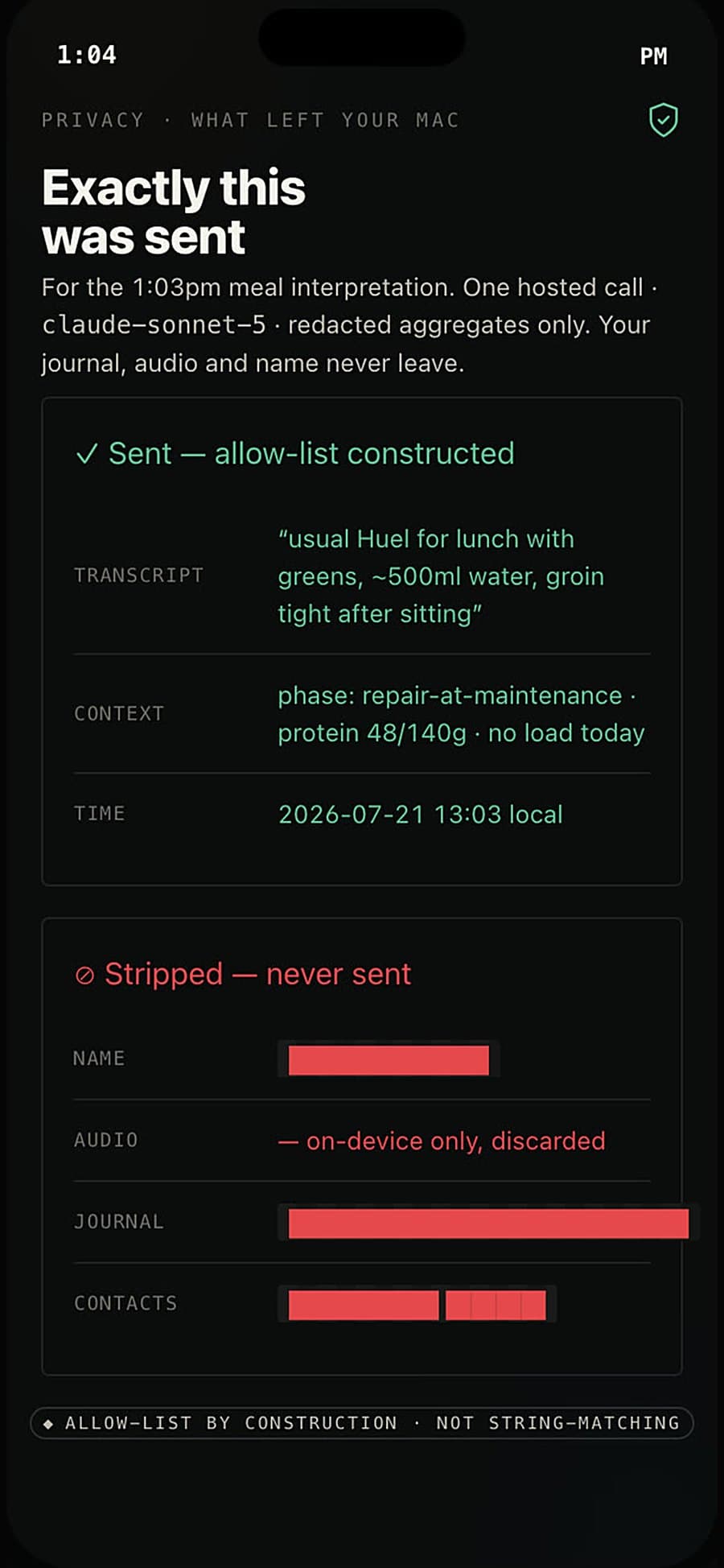
The boundary with Anamnesis has not moved. Journals feed the record through a one-way bridge; nothing crosses back. No reading, no journal line, no note out of the library leaves the file — not for a share card, not for this page.
Nobody becomes disciplined by deciding to be. You become it by doing the thing again, and the system exists to make the next thing obvious. The name is the whole thesis: a disposition isn’t chosen, it is acquired.
03 / 20 · Hexis — Three clients over one record
The iPhone runs the daily loop, the Watch takes the glance and the capture, and the Mac and the browser read the same state; no client keeps a truth of its own.
I say what happened and the speech becomes structured events I confirm, rather than forms I fill.
Every reading is appended with its source, its confidence and its provenance, nothing is overwritten, and the ledger stays dumb on purpose.
Deterministic projections recompute any day from the raw events the same way every time, so code does the arithmetic.
Above the ledger sits a continuously updated model of my physical state, and the model does the interpretation.
Every want arrived as a module on the same clock, scheduler and record, never as a second app.
A nightly job reads the sources I curate and turns what changed into a finite brief, pushed to the phone headline first.
A cloud routine writes a tooling radar twice a week, Hexis files it as a module, and its one write route is the only thing that crosses the edge.
Journals feed the record through a one-way bridge, and nothing crosses back.
A sparkle button opens a conversation with a headless session on my always-on server, with the live API behind it and the deployed source in front of it.
THE FRAMES — 20 OCT 2026
THE FIRST DRAWINGS
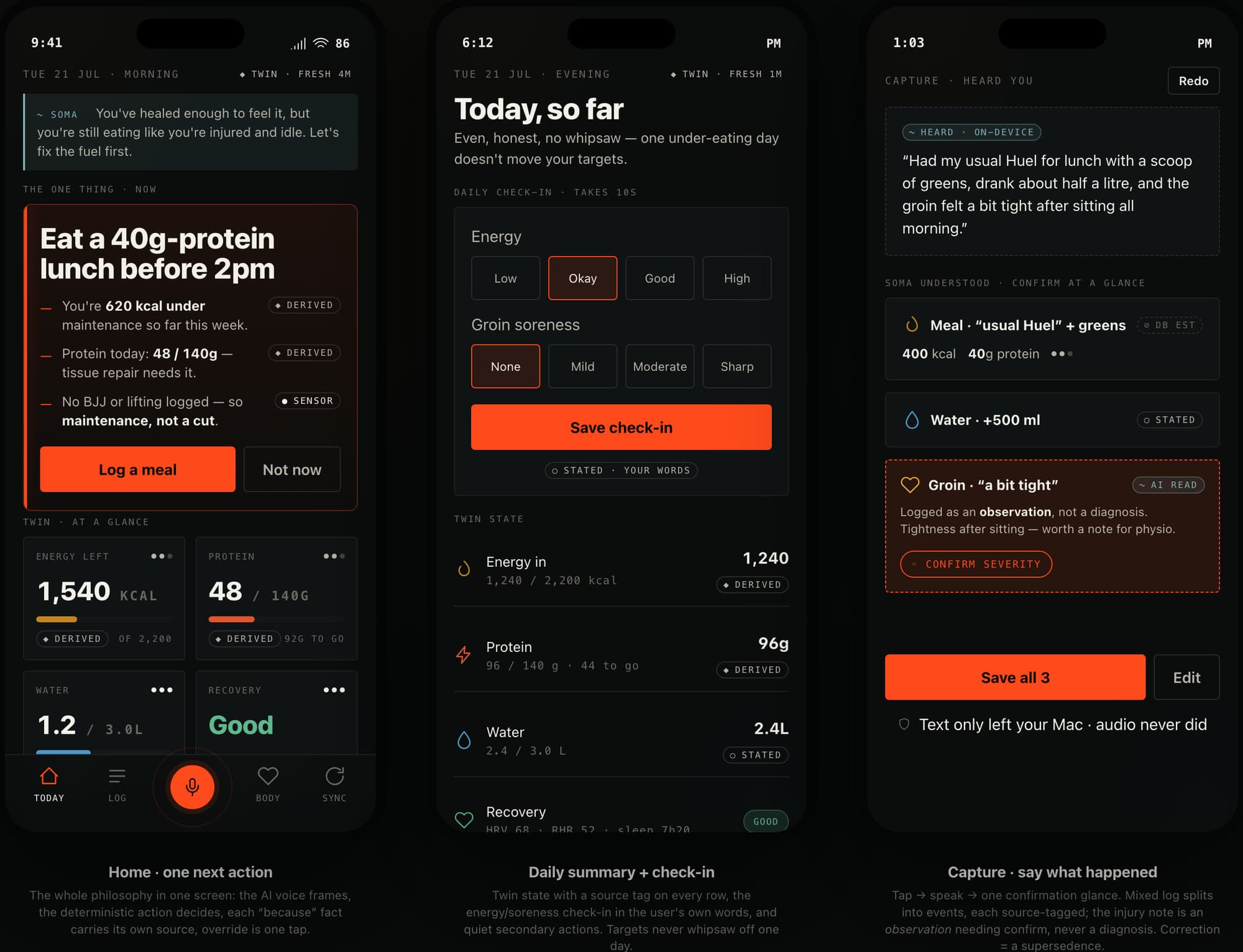
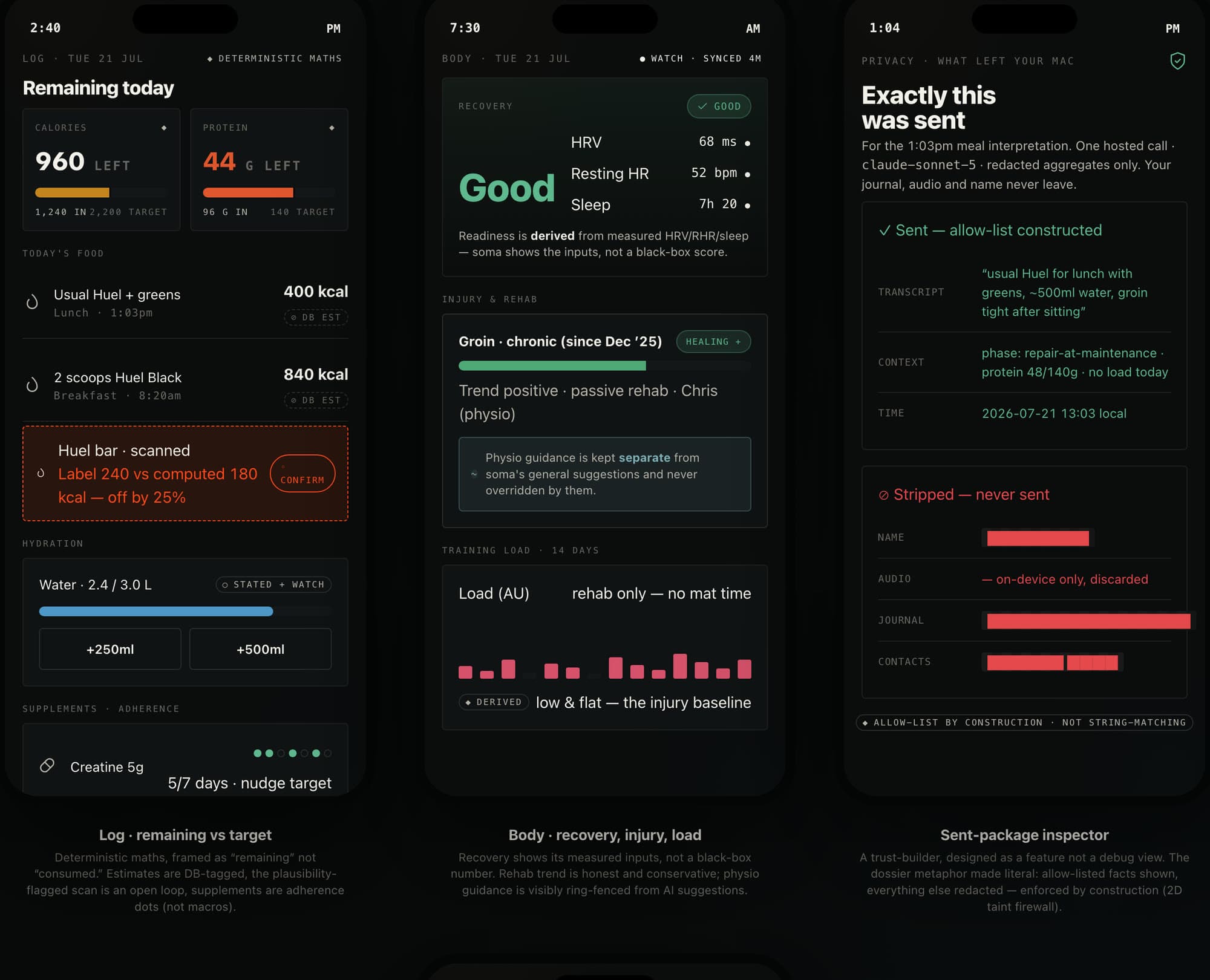
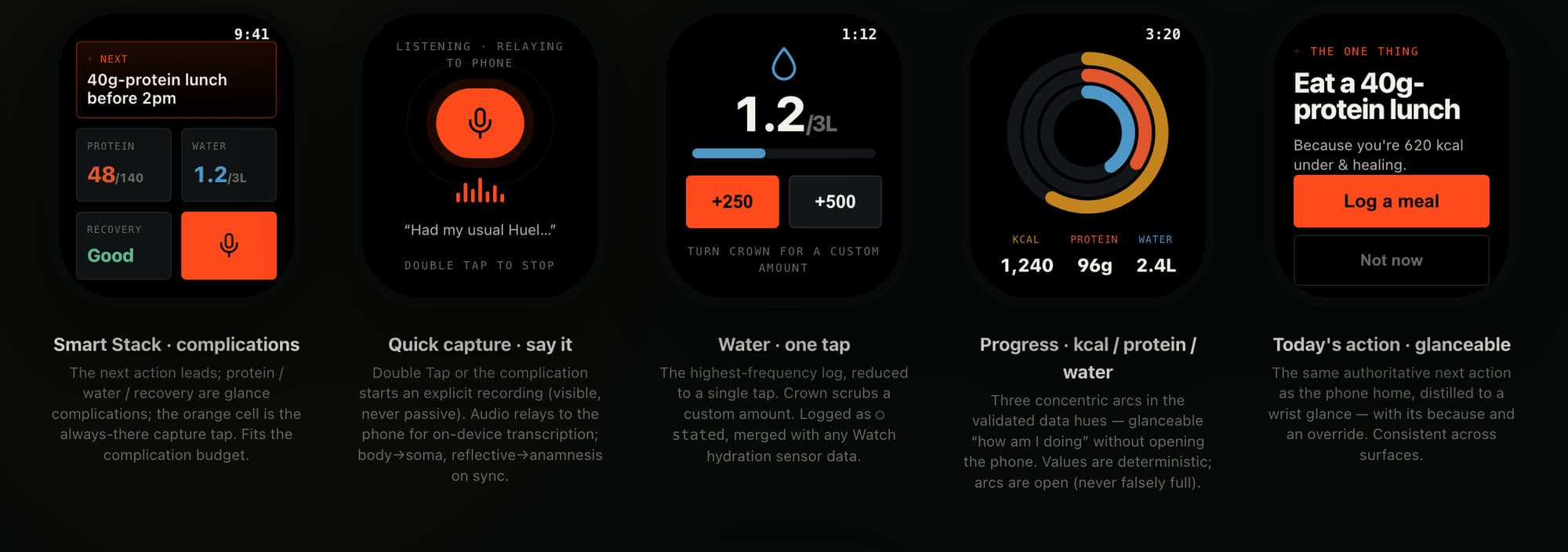
THEN AND NOW
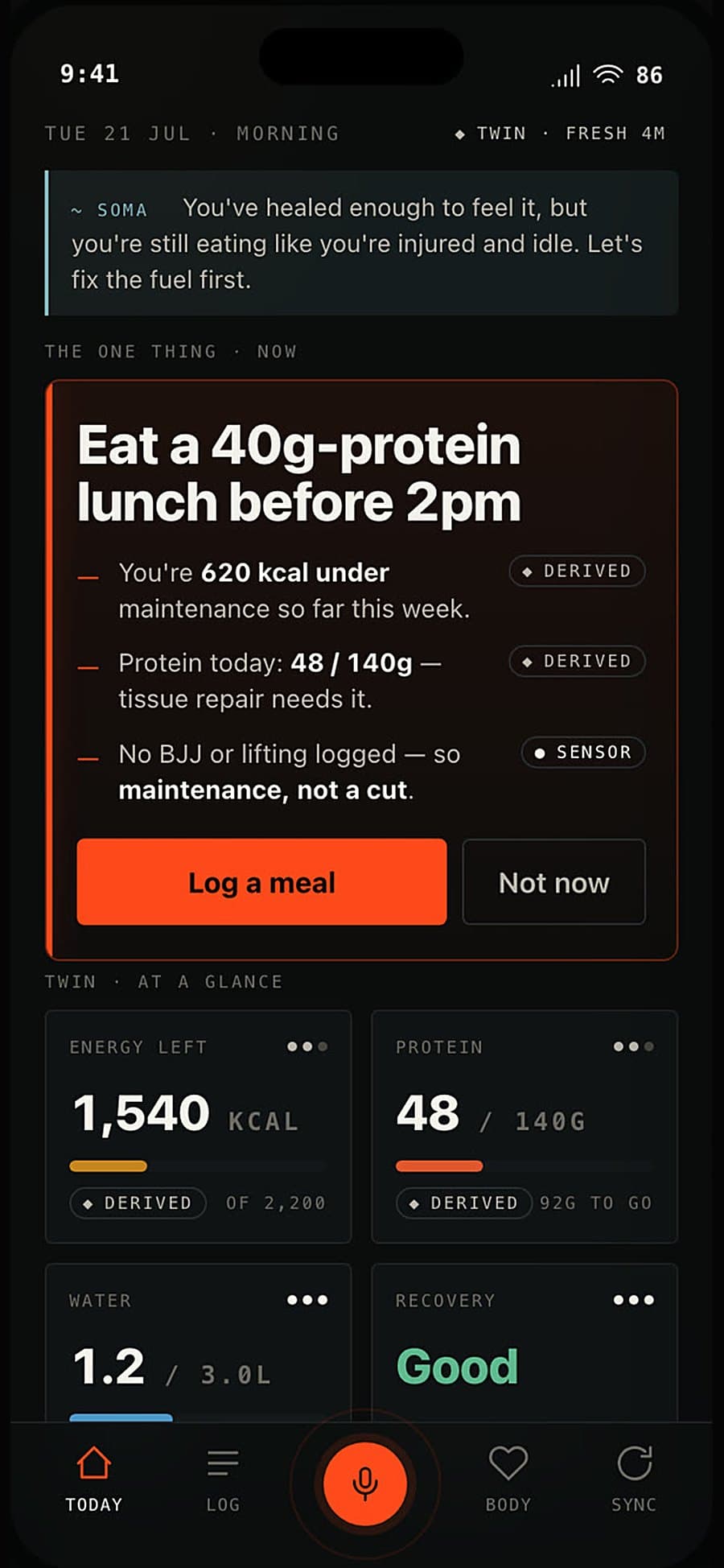
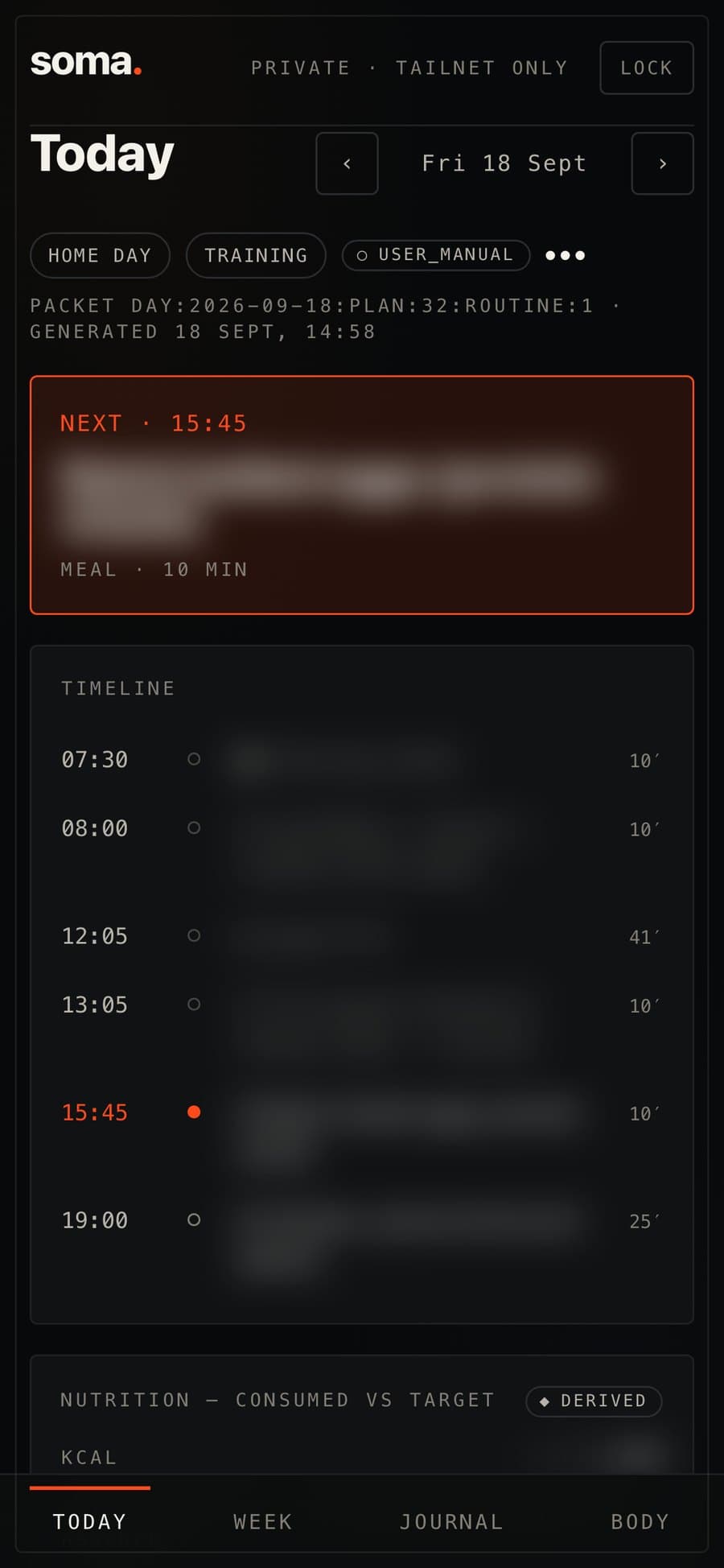
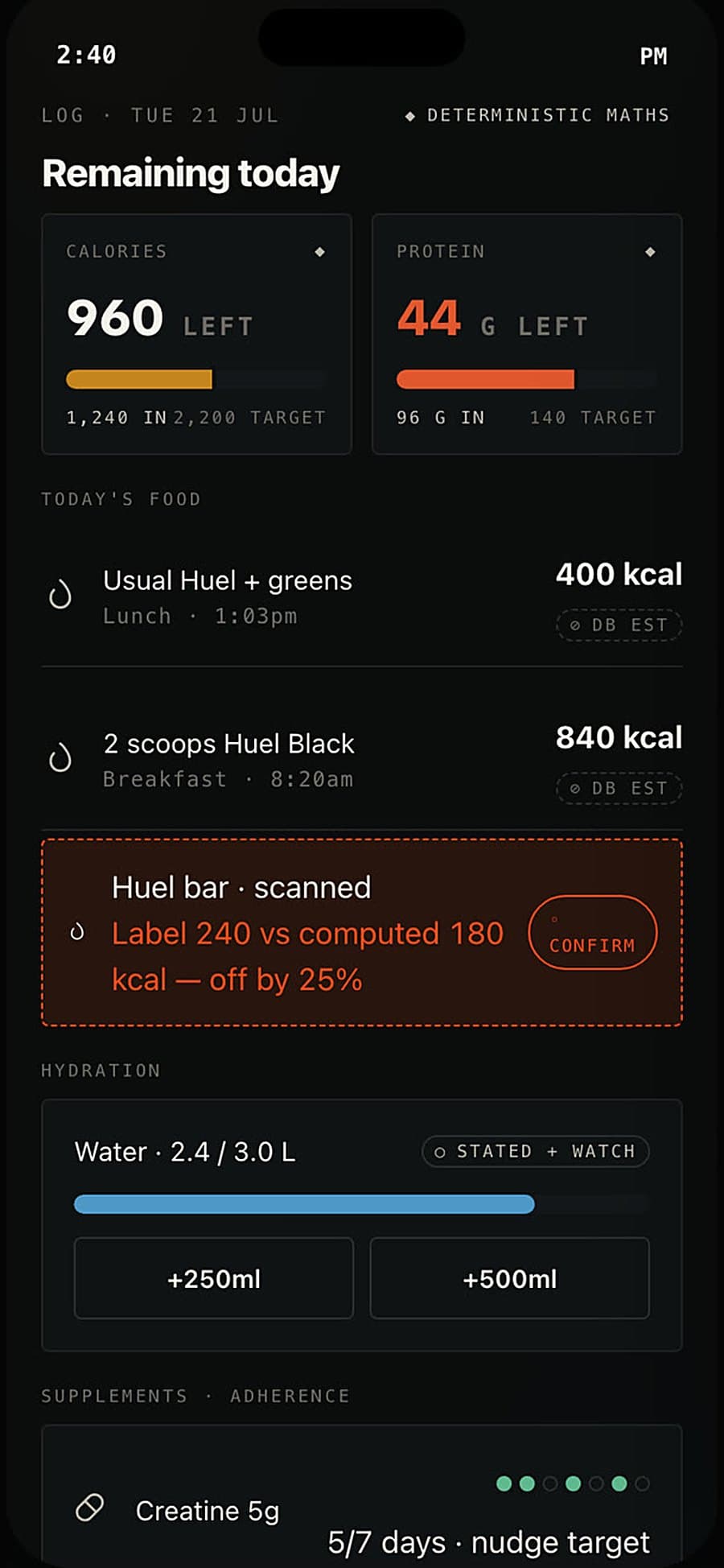
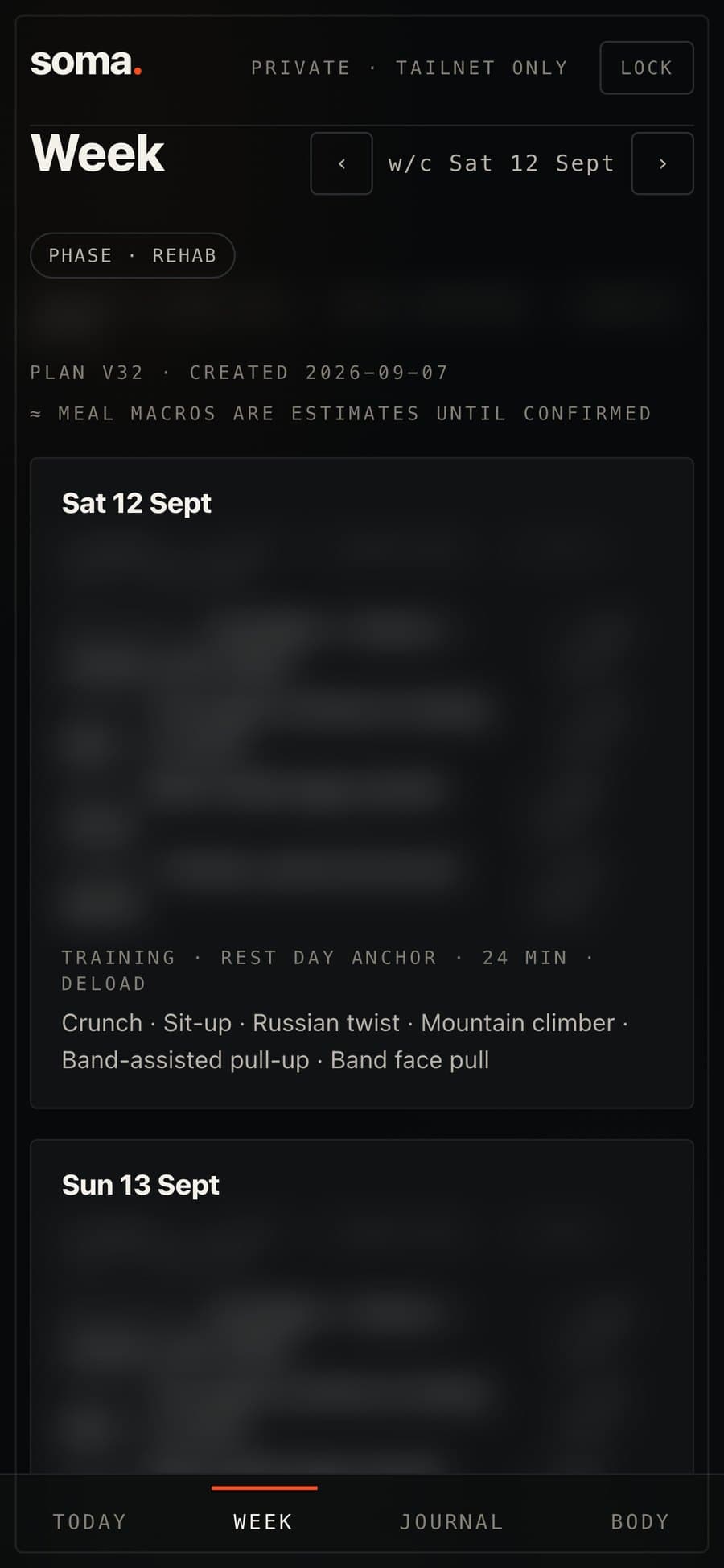
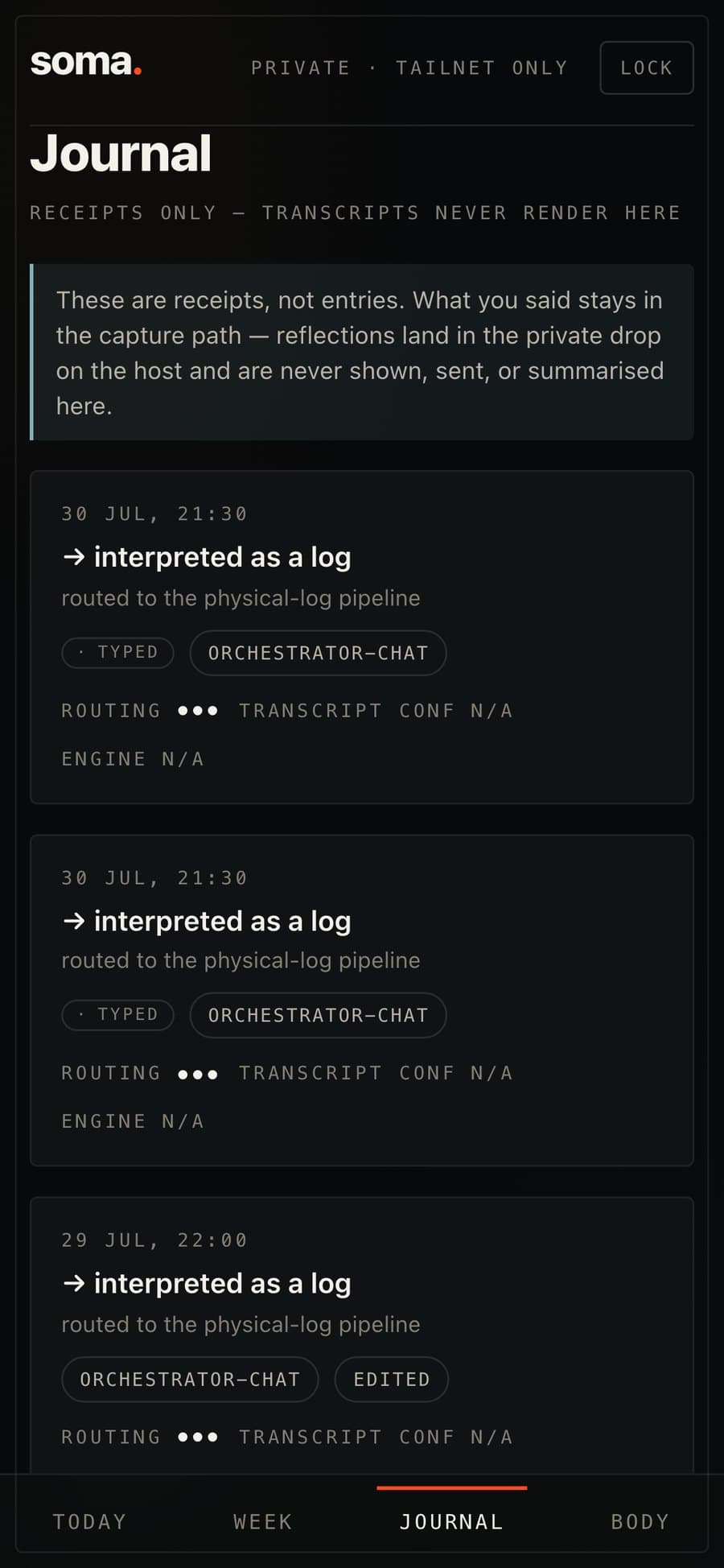
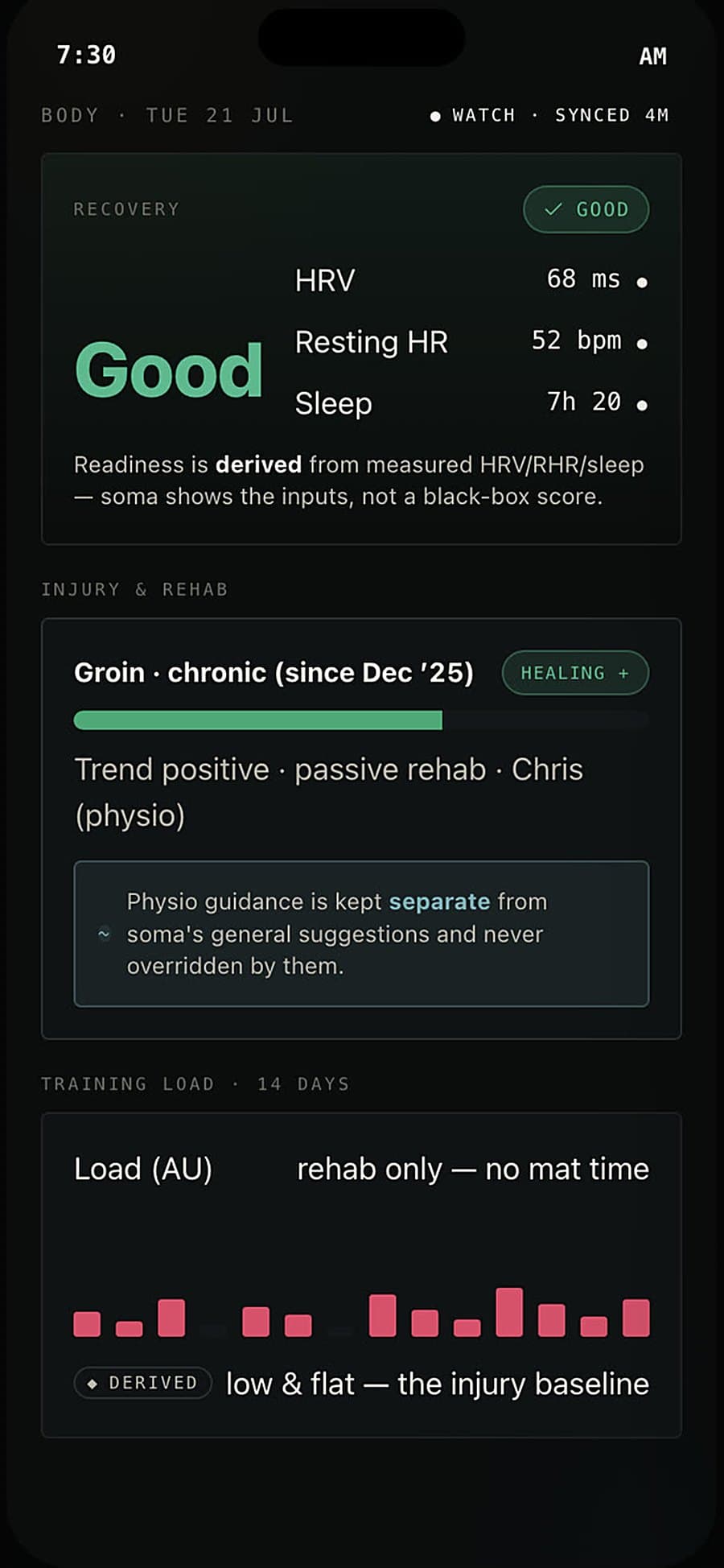
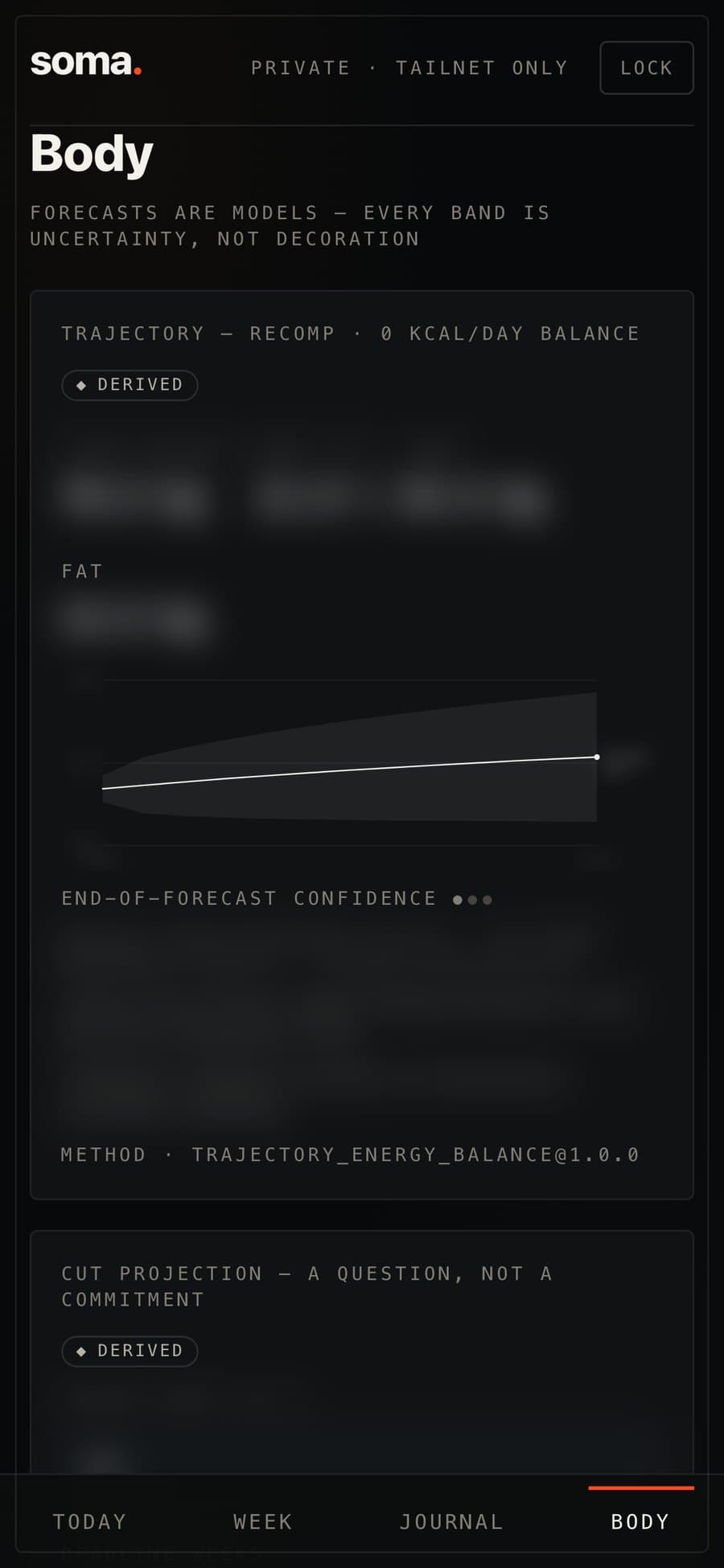
Those three are drawings. I made them before the thing existed, to decide what it ought to be. What follows is the machine. On the left, the screen as it was drawn. On the right, the same surface photographed this afternoon in a phone-sized browser, running against my own record.
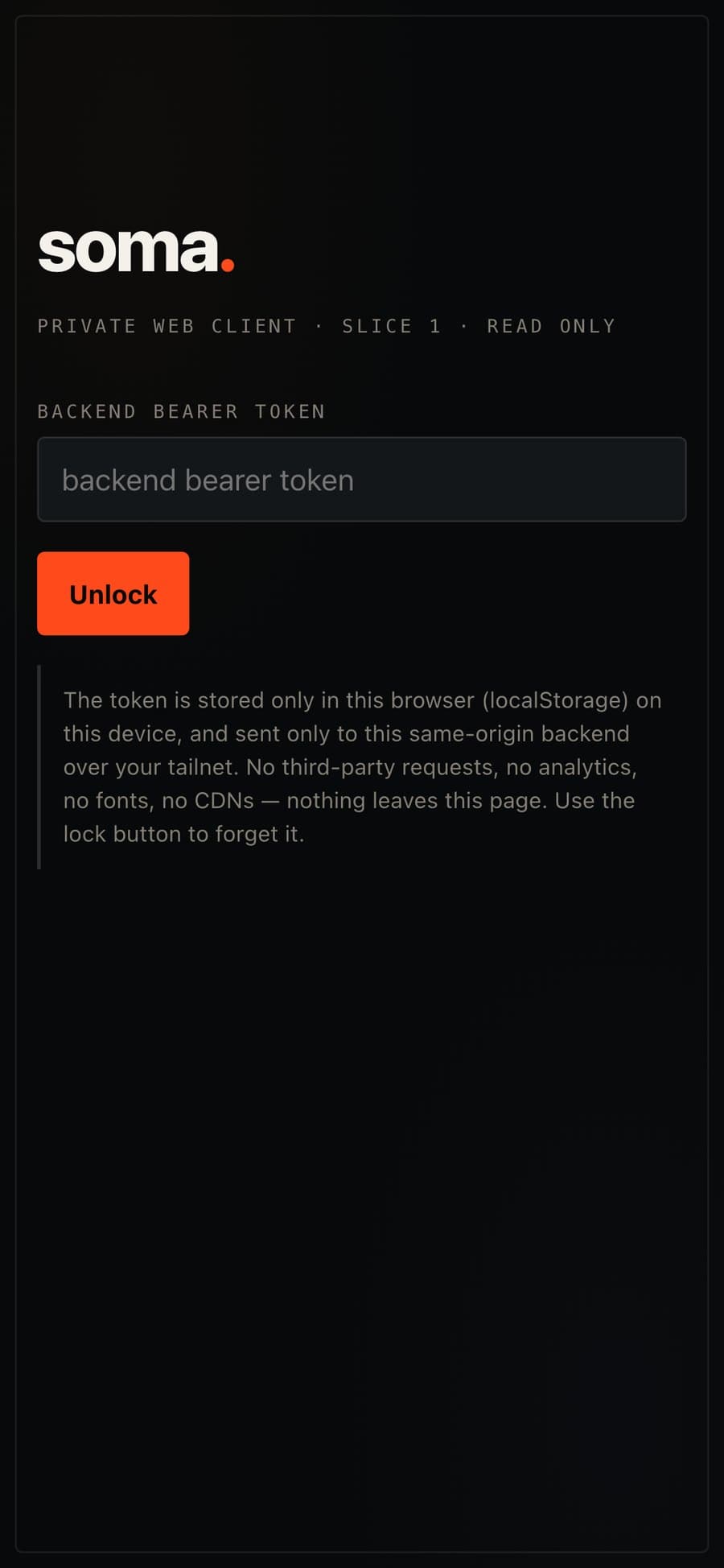
The browser is the third client and the smallest of them — read-only, four views, a bearer token, a private mesh. Learn, Mind, Life and the bridge live on the phone and the watch and have no frame here; the library, the brief and the conversation stay where they are. Where a frame carried a real meal, a macro, a plan figure or a body number, it was blurred in the browser before the picture was taken, so no such value is in the file at all. The blur is not styling. It is the rule the whole system runs on, shown once.
TODAY
THE LOG BECAME THE WEEK
CAPTURE BECAME RECEIPTS
BODY
WHAT LEAVES THE HOUSE