Flight Finder.
DISCOVER
VERIFY
SCORE
ALERT
Flight Finder.
The deal-alert newsletter, rebuilt as personal infrastructure. I know the mechanism — so I built the machine.
The subscription services that email you cheap flights work off a known mechanism: cached fares from real searches, odd routings, prices that briefly fall through their own baseline. I’d tried the idea once before as a custom GPT for reward flights — used it once, shelved it. The idea was right; the form was wrong. It needed to be a pipeline, not a conversation.
So: discovery pulls candidate fares from cached market data across close to two hundred routes out of every London airport — Heathrow, Gatwick, Luton, City and now Stansted, the full set. A verification pass confirms the interesting ones against live fare searches before anything reaches me. Every candidate gets an explainable 0–100 deal score across nine weighted components — discount against baseline, destination preference, stop quality, trip-length fit, departure time, absolute price. Nothing scores against a guess: the system derives rolling benchmarks from its own recorded price history, and every alert stores the baseline and method behind its claimed saving.
It runs daily now, and alerts are capped and cooled down so Barcelona can’t spam the feed — extraordinary deals fire immediately, the rest hold for the digest, each with tap-to-book links. Long-haul deals only qualify if the stay justifies the flight — no £1,000 weekend in Sydney. A business-cabin sweep runs alongside the economy pass — scored against its own premium baselines, kept in their own category and never mixed into the economy ranking — because a mispriced business fare is where one deal pays for years. And it learned honesty from its own feedback: a £60 fare that departs at 05:40 from an airport an hour out of the city isn’t really a £60 fare, so red-eye and transfer warnings sit inline on every departure that deserves one.
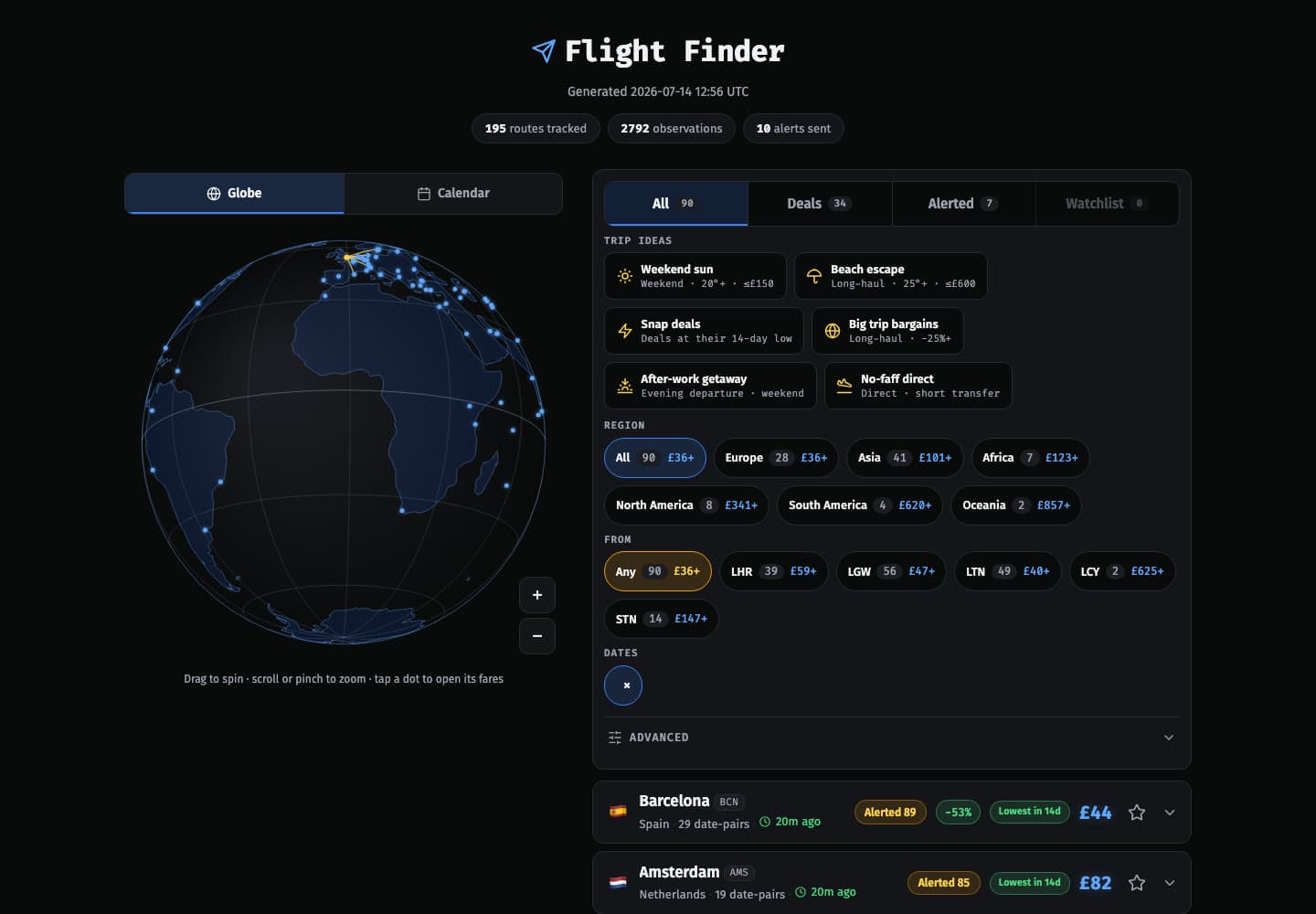
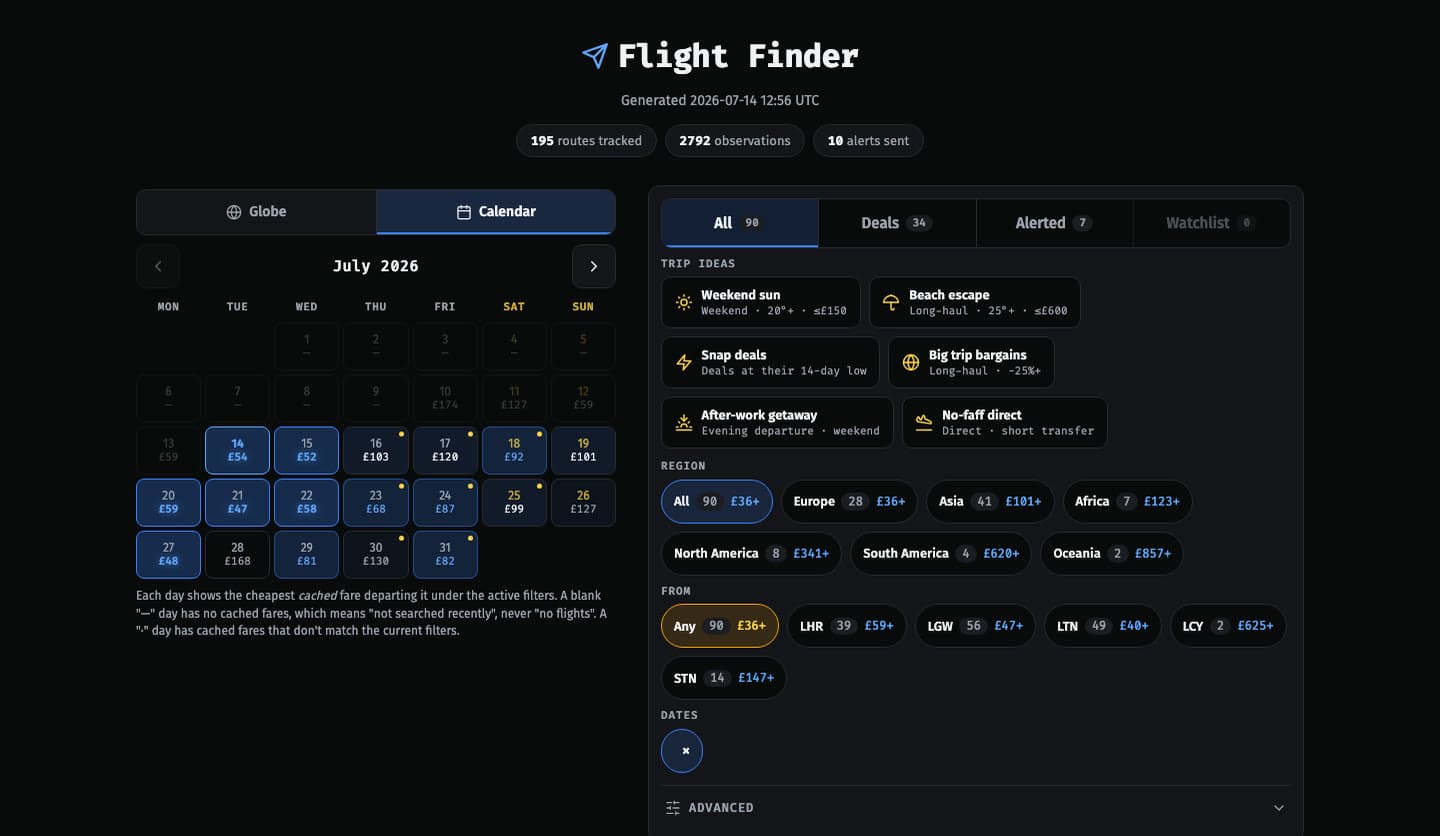
The whole system costs nothing to run. No database, no server — a scheduled workflow verifies, scores, rebuilds the dashboard, and commits its own state back to git every day. There’s a proper front door now: a landing page with a live sample deal card and an early-access waitlist. And the board behind it has grown into something you actually browse — its left pane is a lens you can flip. The globe answers where is it cheap; the calendar answers the other question — I’m free these dates, where can I go? — laying the cheapest cached fare on every day of the month, and honest that a blank day means not-searched-recently, never no-flights.
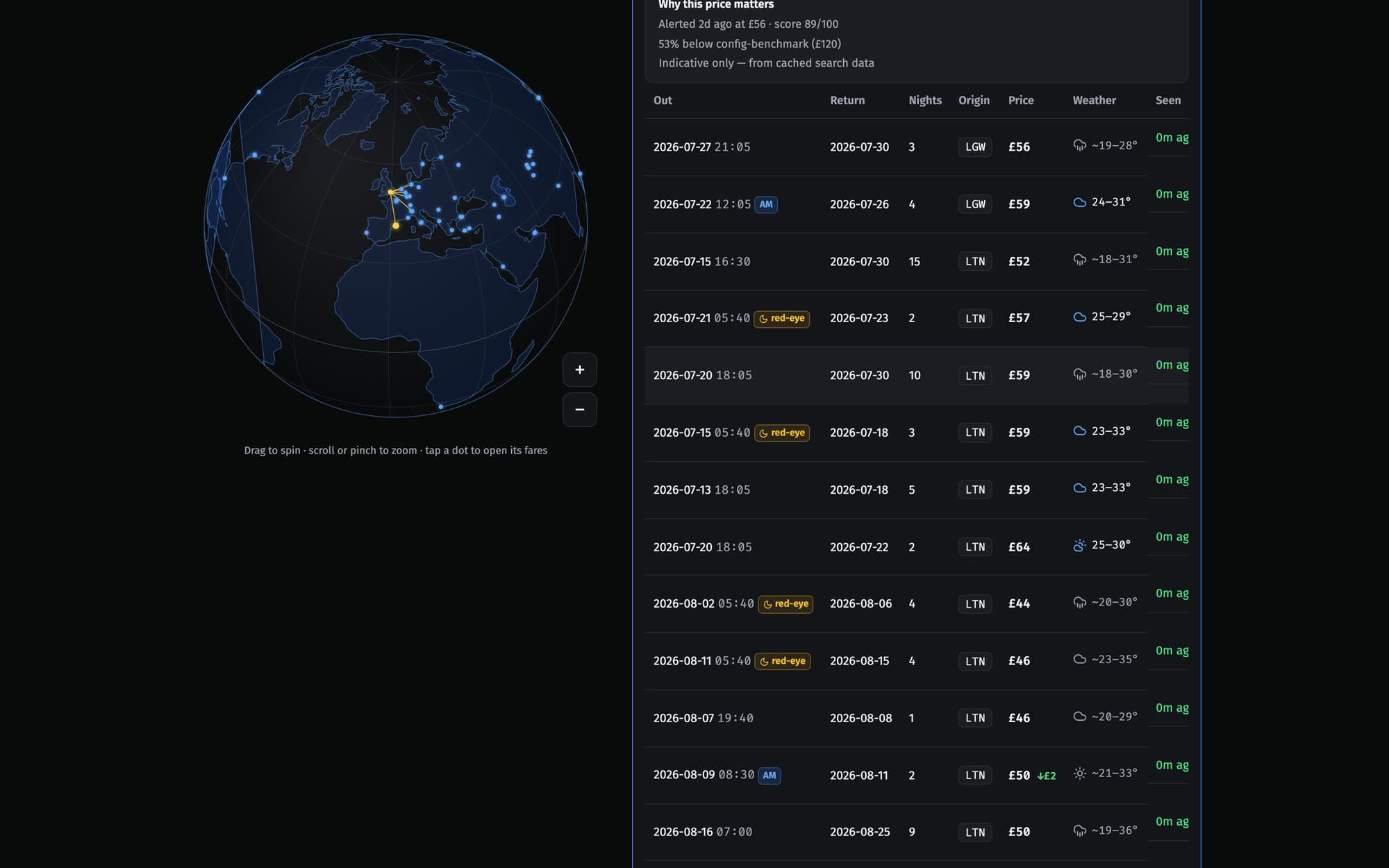
It opens on trip ideas rather than a raw list: one-tap intents that fuse weather, price and timing — a weekend of sun over twenty degrees under £150, a long-haul beach escape, deals sitting at their fourteen-day low, big-trip bargains a quarter below baseline, an after-work getaway, a no-faff direct with nothing worse than a short transfer. The list is tabbed into all, deals, alerted, and a watchlist of the routes you’ve pinned; region, departure airport and dates cut across the top with the rest folded into an advanced drawer; each destination carries a price sparkline, a “lowest in 14 days” pill, urgency read straight from the price history so a fare that’s climbing says so, and a share action that hands a single deal card to whoever needs convincing. Destination weather sits inline — a real forecast when the trip is close, last year’s same dates honestly labelled “typical” when it isn’t — and an explain box on every price shows exactly why it mattered.