FlatSignal.
WATCH
DEDUPE
SCORE
ALERT
FlatSignal.
London rental intelligence for the moment that matters. Good flats go before the viewing — this one watches so you don't have to.
Everyone who has hunted for a flat in London knows the feeling: you find the one, you message about a viewing, and it’s already gone. A year and a half ago I was helping someone close to me search for short-term stays, watching that loop play out daily, and thought: this should be a system. Back then I couldn’t build it. Now it takes a day.
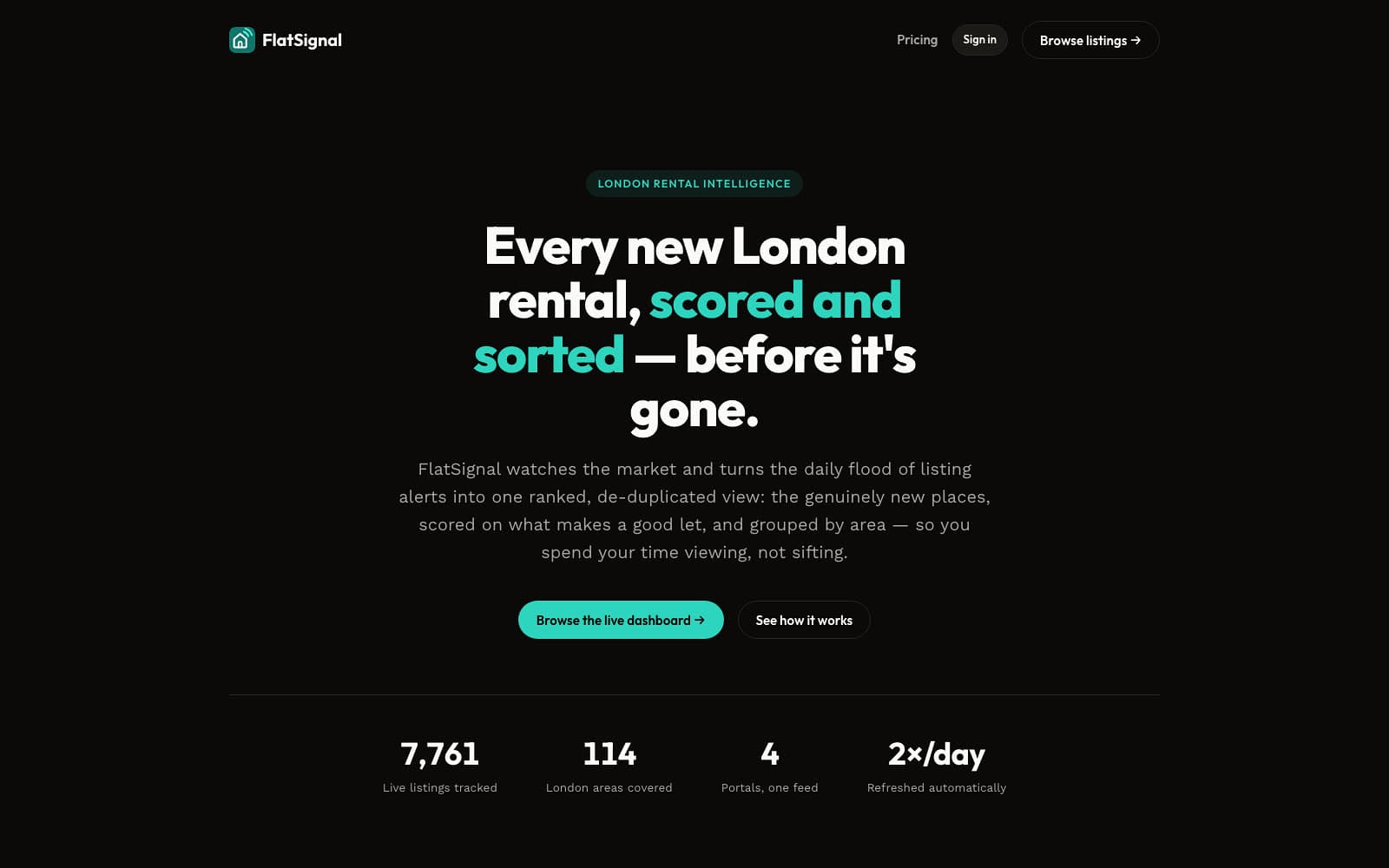
FlatSignal watches new London listings on a half-hourly cycle, normalises and dedupes them into distinct properties, and scores each one 0–100 with a deterministic model — preference match, real commute minutes from TfL, value against the rolling area median, freshness, completeness, source confidence. No black box anywhere in the ranking: every score ships with its own breakdown, the weights showing, and a plain-English “why it matched.” When something clears the bar, the phone gets a push with the score, the reasons, and a tap-through to the listing — fast enough to be first in the queue.
The part I’m proudest of is what it refuses to do. There is no compliant public feed of London listings, so FlatSignal doesn’t scrape — it ingests the portals’ own saved-search alert emails from a dedicated inbox, under my own accounts, facts and deep-links only. And the scoring has teeth: a “luxury three-bed” at a too-good-to-be-true rent with MUST-GO-TODAY language gets marked down hard and its warnings carried on every alert — the scam patterns every London renter has met, encoded as penalties. Warnings are never silently dropped.
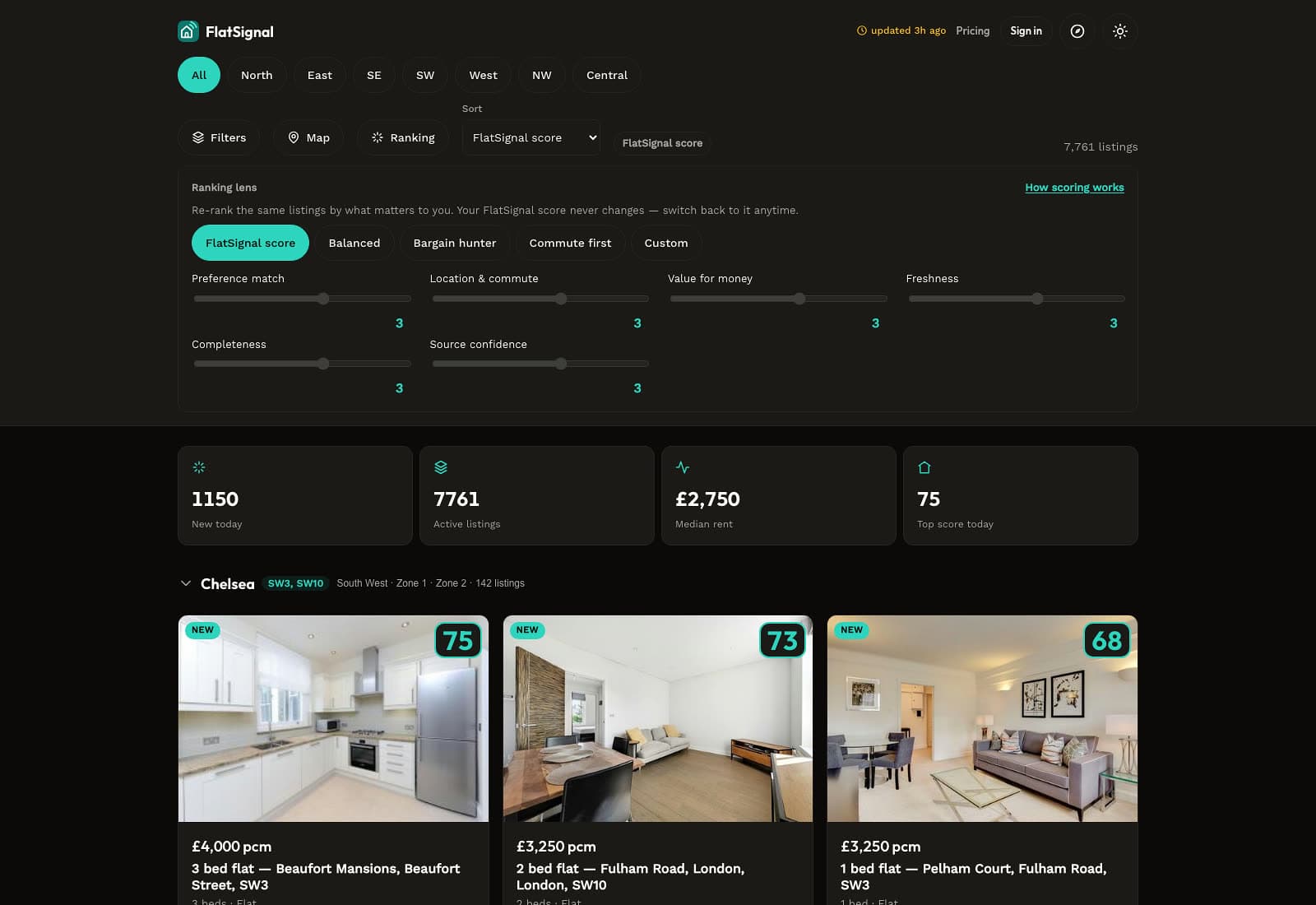
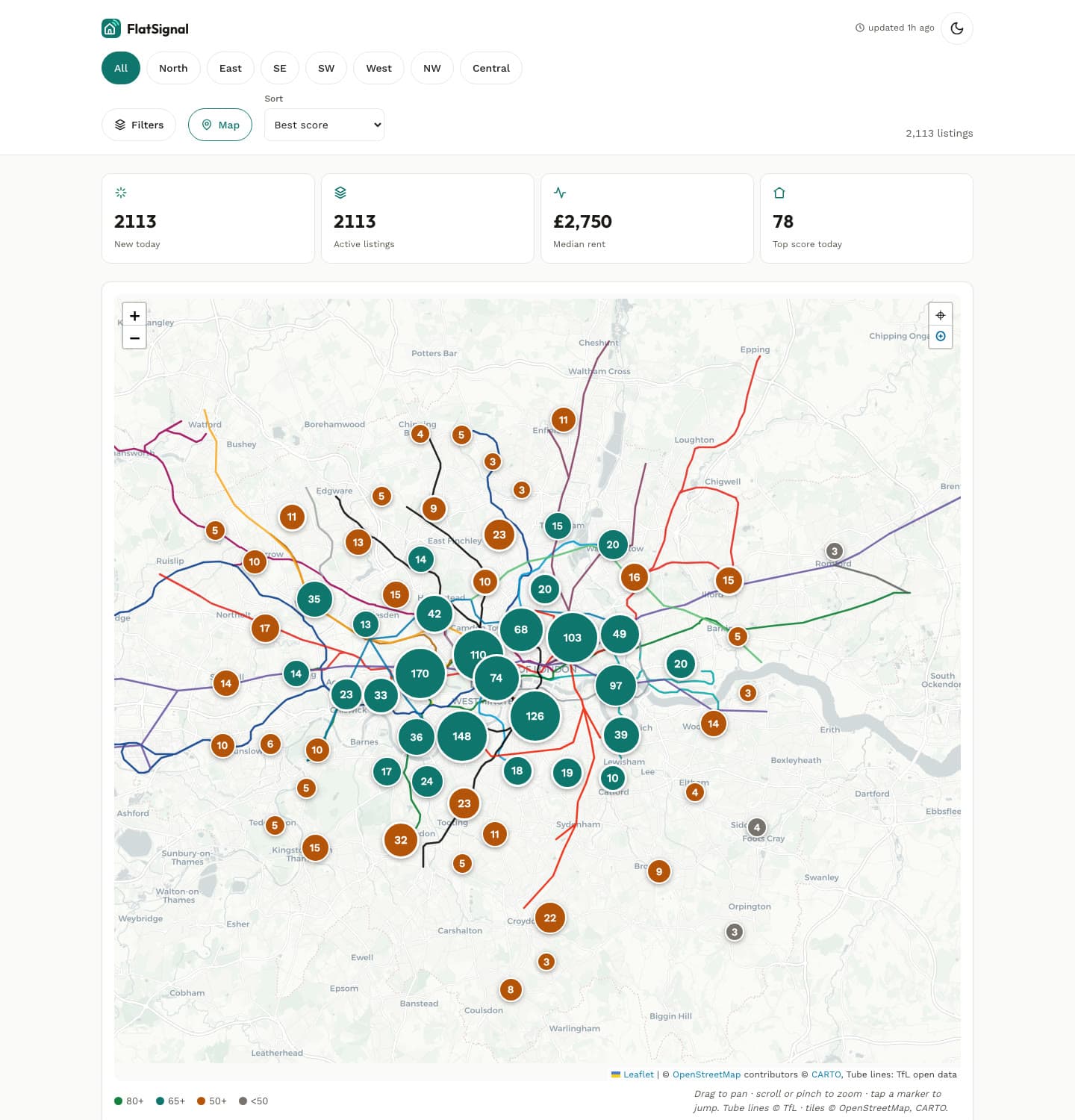
It started as a day’s build; it grew into the real thing. FlatSignal now ingests every new listing across four portals — Rightmove, Zoopla, OnTheMarket, OpenRent — nearly eight thousand live at a time, each with its photo, folded together across sources, sectioned into a hundred-plus London areas. The dashboard has teeth to match: filter by beds, price band, type, furnishing, freshness, nearest tube and rail line, TfL zone, or minutes-by-tube to a hub like Bank or Canary Wharf; flip the whole thing to an interactive map of the city — real streets underneath, every tube, Overground and Elizabeth line drawn on in TfL’s own colours, listings clustered by area and coloured by score; drill into a line or a single station; and re-rank everything through a personal lens — six sliders that weight the score toward what you care about, bargain hunter to commute-first, without ever touching the honest baseline score.
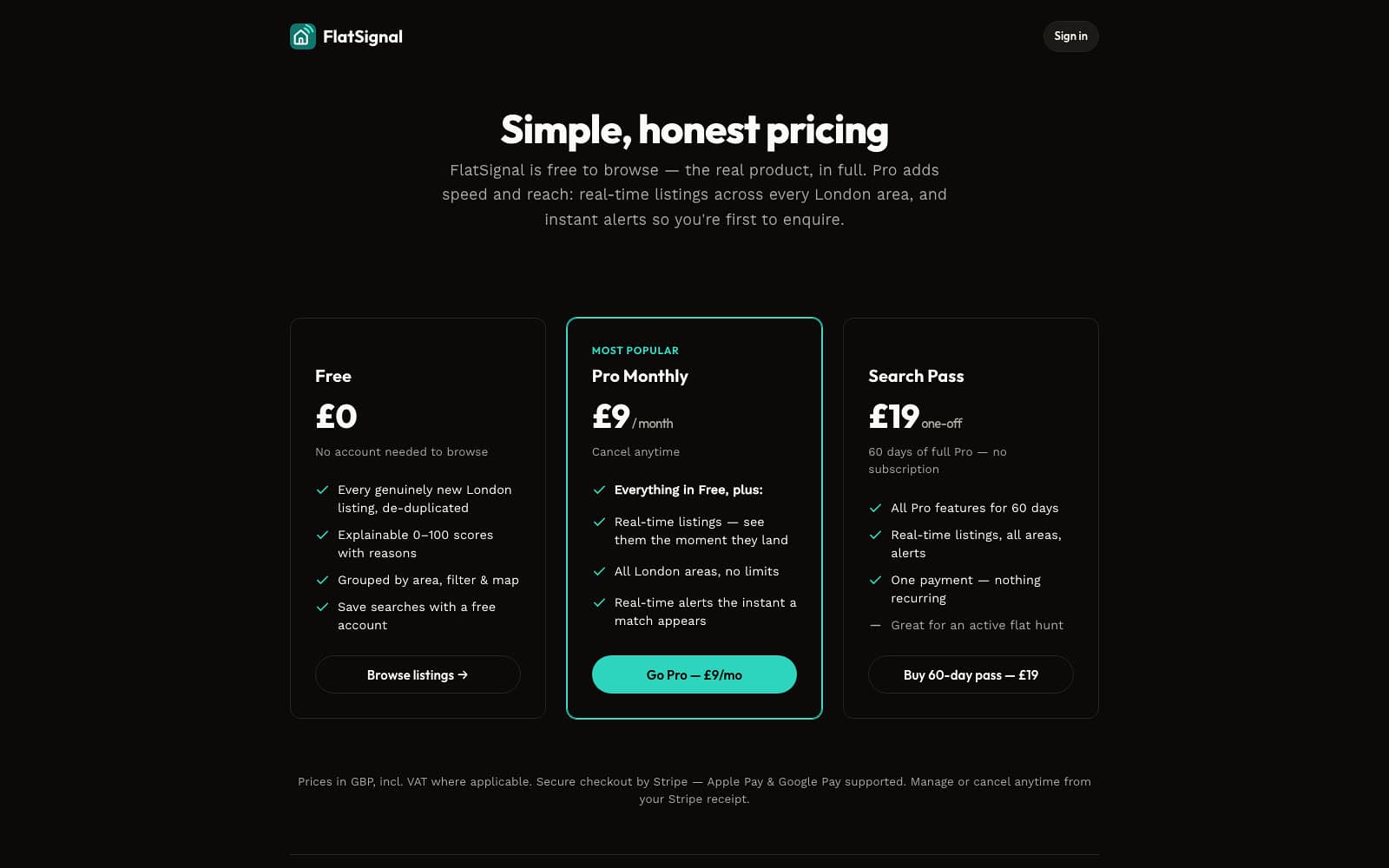
Then, in the third week of July, it stopped being a side project. FlatSignal went through the commercialisation platform as run one and came out the other side a real product: its own domain, accounts with Google sign-in, a free tier that gives the whole product away for browsing, a Pro tier with real-time listings and instant alert emails when a saved search matches, checkout and entitlements wired end to end, legal pages, analytics, error monitoring, uptime checks, even the bookkeeping — roughly three days from Vercel side project to revenue-wired business. The catalyst for caring was personal: someone in my family mentioned her daughter was flat-hunting in London, I showed her the board, and watched it land the way only a real problem being solved lands. The data underneath is still the same architecture as the surf and flight systems — scheduled runs committing their own state, a hand-written dashboard on top — and London deliberately kept out of the core code, so a second city is a config file. Just a little thing to help people. You never know where it leads.